Make a Google Images search for ‘landscape’, ‘portrait’, or any ordinary subject such as ‘apple’ or ‘sunset’. Add a screengrab of a representative page to your learning log and note down the similarities you find between the images.
Now take a number of your own photographs of the same subject, paying special attention to the ‘Creativity’ criteria at the end of Part One. You might like to make the subject appear‘incidental’, for instance by using focus or framing. Or you might begin with the observation of Ernst Haas, or the ‘camera vision’ of Bill Brandt. Or if you’re feeling bold you might forget about your camera completely and think about the tricky question of originality in a different way – htttp://penelopeumbrico.net/index.php/project/suns/
Add a final image to your learning log, together with a selection of preparatory shots. In
your notes describe how your photograph or representation differs from your Google
Images source images of the same subject.
I smiled when I read the Ernst Haas quote about the apple. I had similar feelings when I was taking my images for Assignment 3 of the banal kitchen. It was also a feeling that came back to a lesser extent for my images for assignment 4 where the selection of mundane ignored objects become the central focus – hopefully showing as much natural beauty as a precious stone.
It was interesting researching the Mount Fuji work – both the original woodblocks of Hokusai and the personal reflections of Fuji from John Davies and Chris Steele Perkins.
All three show the mountain as a backdrop for people getting on with their daily lives though of course you could argue that the woodblock work of Hokusai is simply beautiful art rather more than a social commentary but with the volcano reduced to merely background in some of the work I’m not so sure.
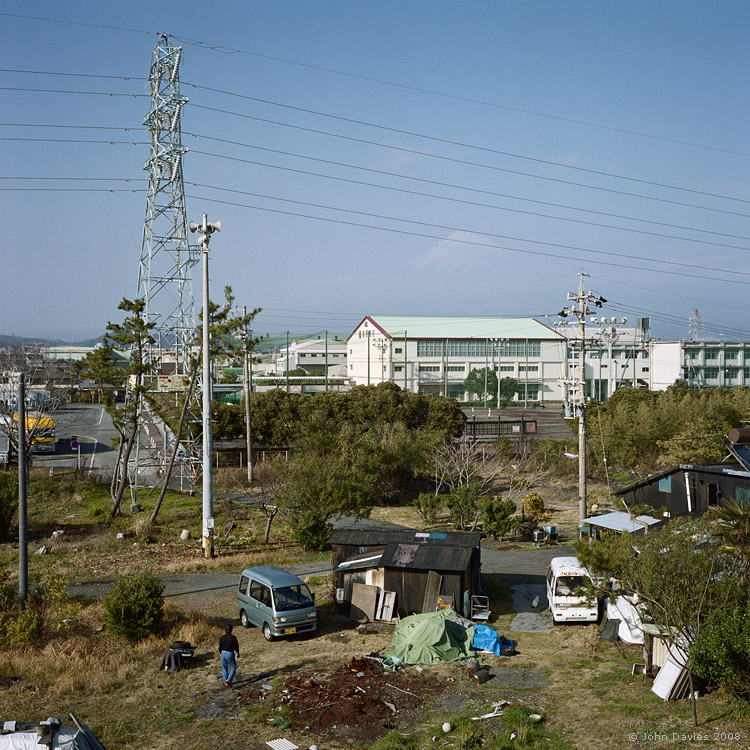
Davies, J (2008) Fuji City – courtesy of johndavies.uk.com 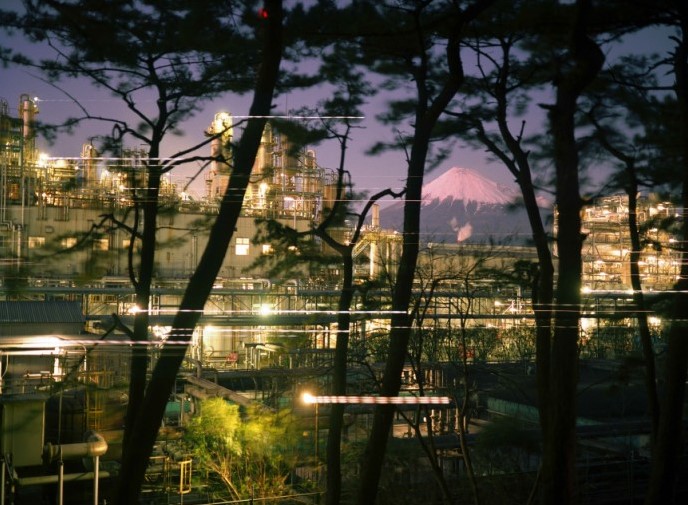
Steele-Perkins, C (2000) Mount Fuji – Refinery at Fuji City, courtesy of prixpectet.com 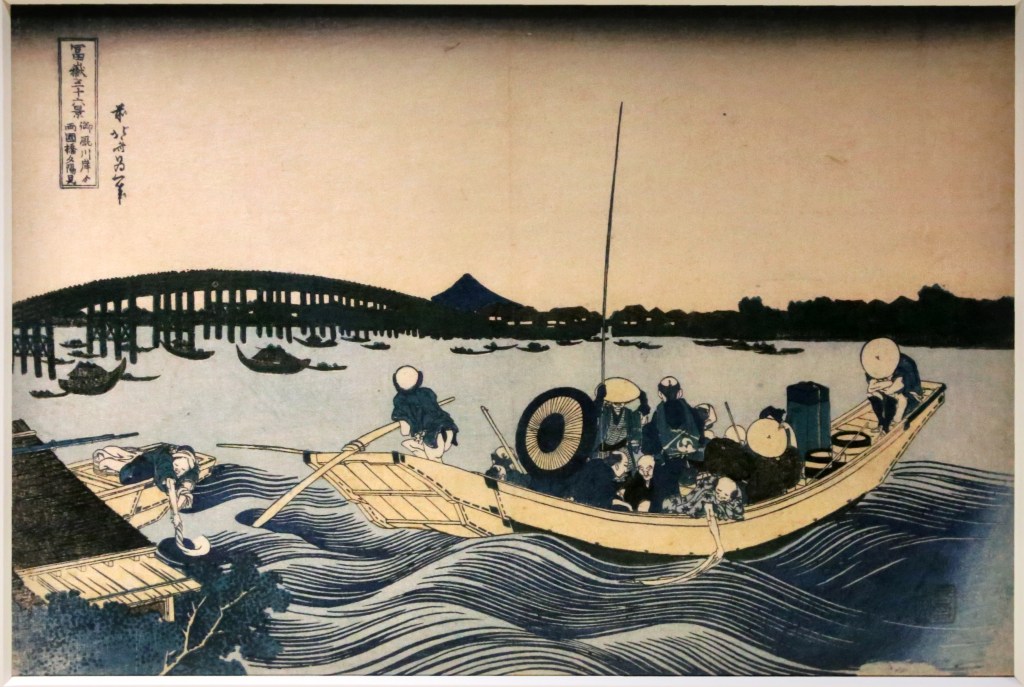
Katsushika Hokusai, Sunset Across the Ryōgoku Bridge, circa 1831, Sumida Hokusai Museum courtesy of Saliko 
Katsushika Hokusai, Sundai Edo, circa 1830, Courtesy of MOMA
Life carries on in the shadow of potential catastrophe whether it’s 1830 or 2008…or 2020.
If I look at my assignments for EYV I hadn’t quite realised that all my images were of mundane, inanimate, largely ignored objects – including the submission thats upcoming for 4. I never considered this. Perhaps it’s the ability to spend time with that object, to observe it fully and probably the ability to leisurely experiment without having to be conscious of my demands on it’s time. Having that time does enable you to have revelatory moments that only long observation can bring (at least with these type of objects – you can get a similar feeling shooting a bird of prey as it flies overhead for example) sometimes whilst you are photographing; sometimes after, whilst in lightroom. I know photography is about creating images but when you spend time taking an image of something that you know has never been looked at in the same way as you are now; it feels almost special, not connected necessarily but perhaps more like a heightened sensory response. It reminds me of something I read recently about looking for fossils on a beach – most people will walk along a pebbly beach scouring with their eyes waiting for something to grab their attention and yes you may get lucky and find something but the best way to find a fossil is to just sit down amongst the pebbles and examine everything around you.
Anyway, I thought for this subject I would take a look at ‘birds’. Bird watching has been a hobby of mine since I was a kid and I knew that any search on google would show page upon page of colourful images like these….
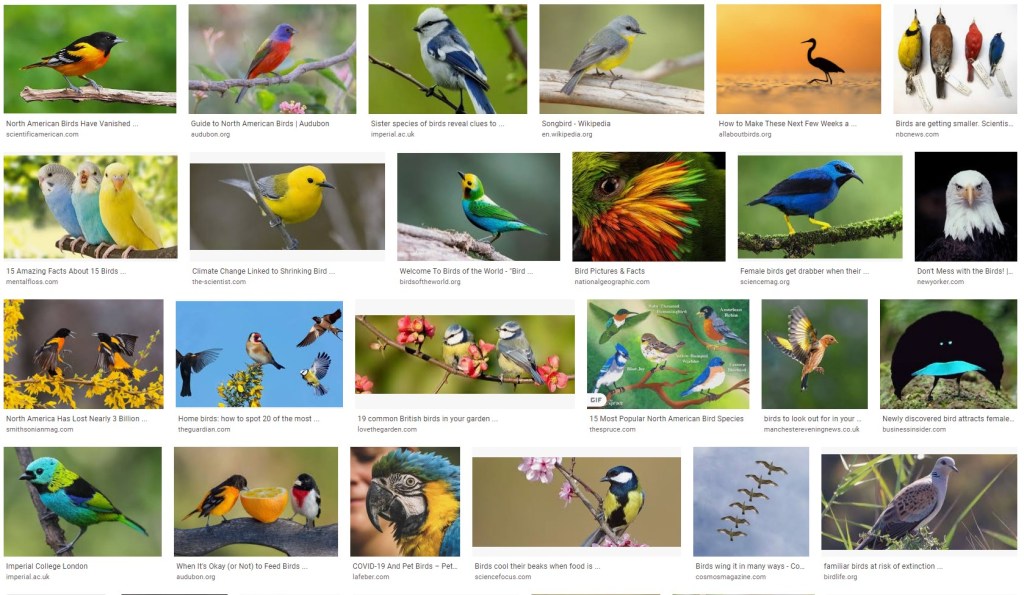
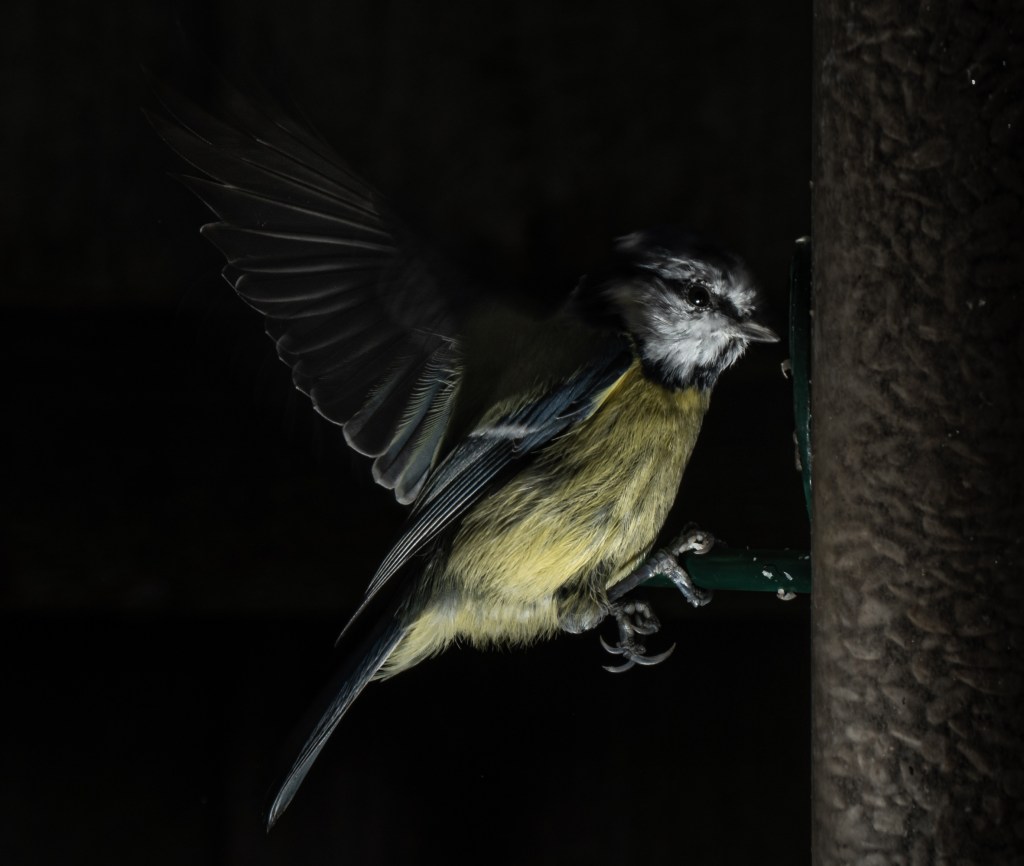
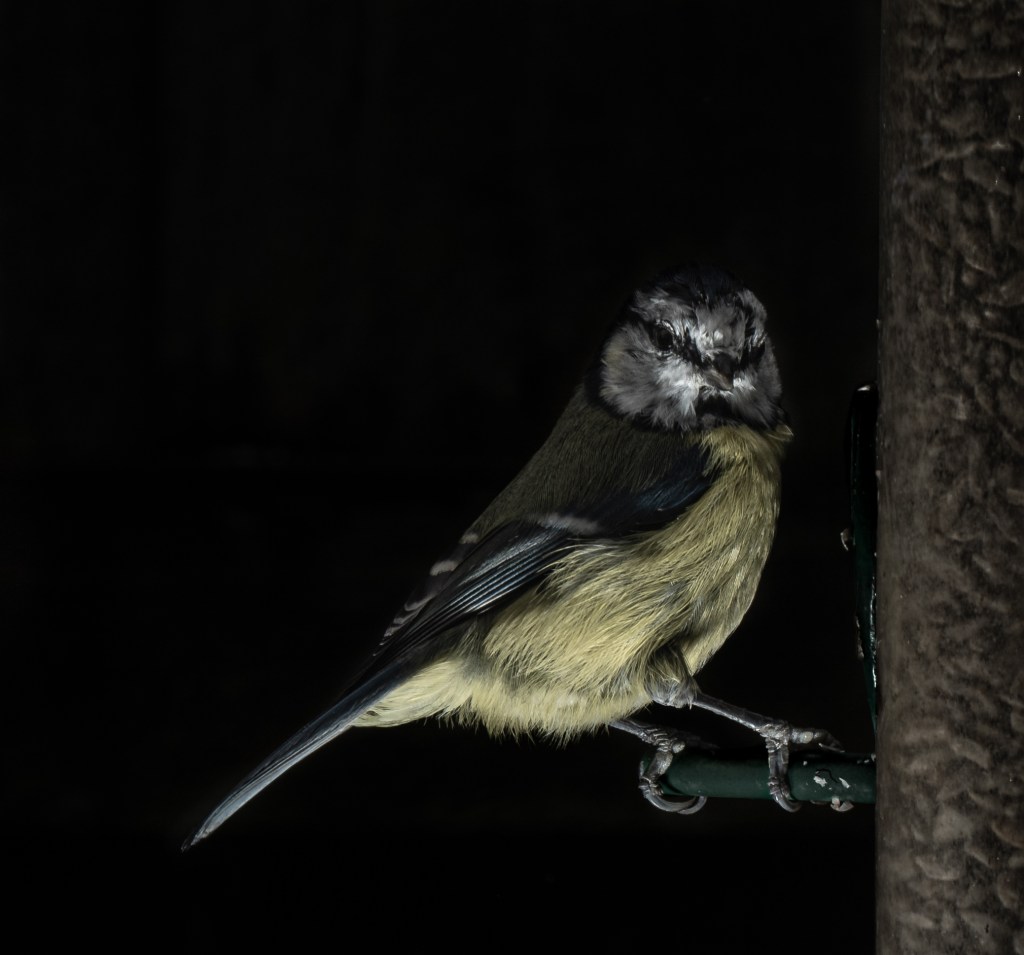
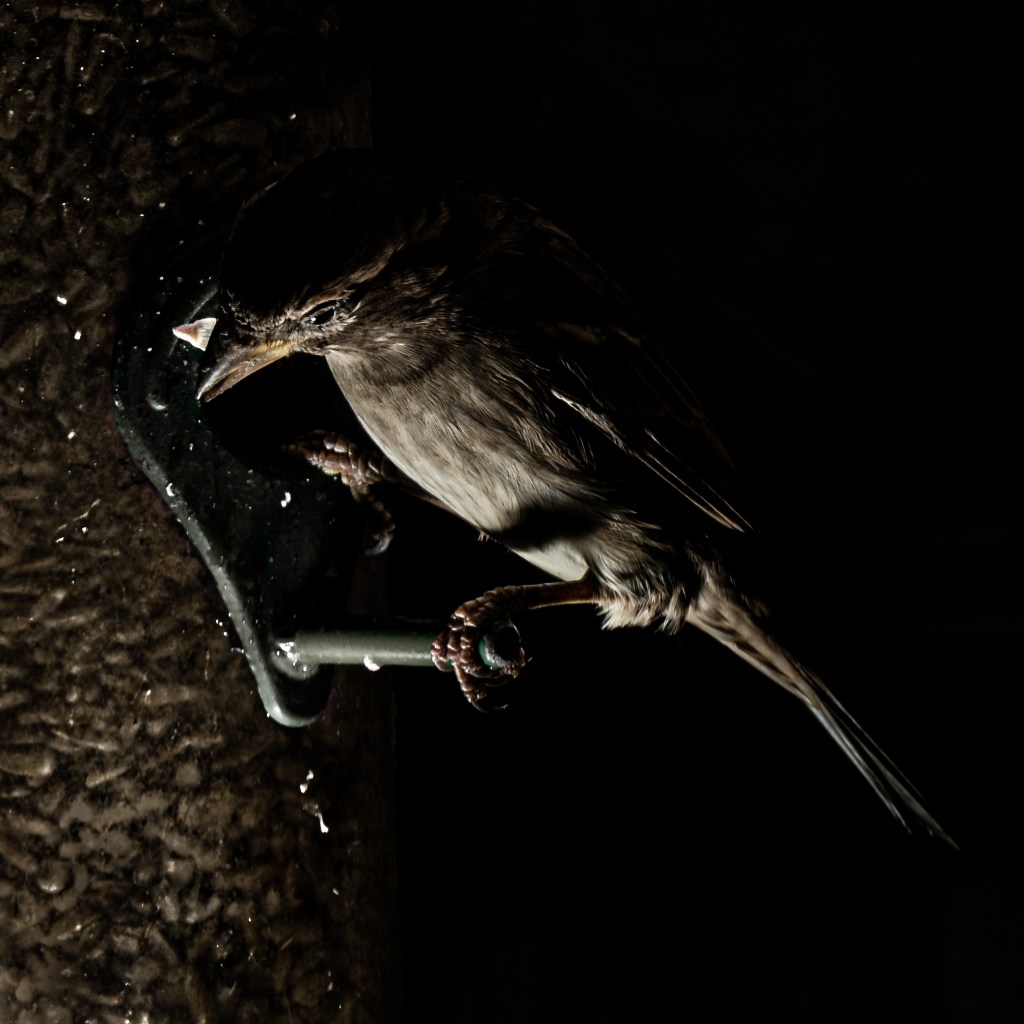
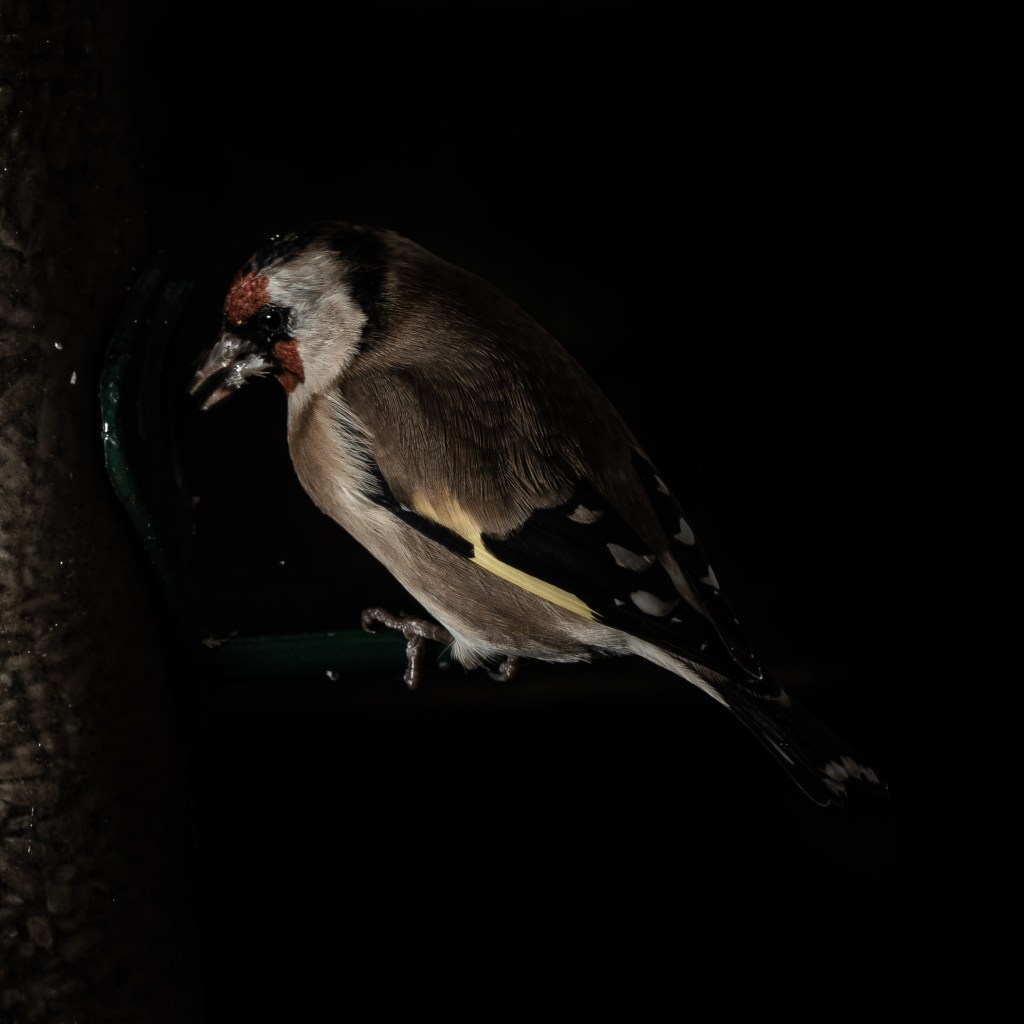
Always looking beautiful, usually taken with giant lenses that blur everything but the subject, a natural environment and for the most part, why not. But for many people the only time they observe birds at all is in their garden – the uk is very fond of feeding it’s birds and I’m no exception. I liked the idea of setting up a camera trained on the bird feeders but I didn’t want a ‘normal’ bird image. Maybe I could try and take some images that I’d never normally bother with but would add a darker twist – they are descendants of dinosaurs after all.
I set up a flash by a feeder with a small diffuser attached to the head hoping to get some uplit shots of birds squabbling. This didn’t quite go to plan, when you introduce anything new it takes a while for the birds to get used to it and the flash gun was too close, the other issue was that the light from the flash would only cover a tiny area so I was limited in the end to shots of them on one perch of one feeder. I think the results are interesting – though birds squabbling with claws raised using the same lighting would produce a far darker and powerful image – I will need to experiment more to see what I can achieve.
I chose this image as the selected one from the 4 below as it’s more dynamic and gives a hint of danger from those claws. I desaturate some of the colour from all of them for a moodier look. It’s clear that these are a world away from the google image search of birds but maybe I went a bit far going for a look that’s completely opposite. It was still a worthwhile experiment and I’m sure if I could spend more time on it I could get the birds fighting images I was initially after – patience and time are definitely required for any wildlife images.
Bibliography
Bill Brandt – an introduction (s.d.) At: https://www.vam.ac.uk/articles/bill-brandt-an-introduction (Accessed 15/11/2020).
Bishop, R. and Cubitt, S. (2013) ‘Camera as Object and Process: An Interview with Victor Burgin’ In: Theory, Culture & Society 30 (7-8) pp.199–219.
Britain in Focus: A Photographic History · BoB (s.d.) At: https://learningonscreen.ac.uk/ondemand/index.php/prog/0E91A8FC?bcast=123721540 (Accessed 15/11/2020).
Brown, H. (s.d.) No Two Sunsets are Alike: Reenvisioning Umbrico’s Suns… Nine Years Later. At: https://www.sfmoma.org/read/sunsets-umbrico/ (Accessed 13/11/2020).
David Bull (2015) The Great Wave – Part 8. At: https://www.youtube.com/watch?v=AQTUKpEF_ok&list=PLK-Wicsj5rAasS2g7e-Z9eFUdG6I7ZqED&index=8 (Accessed 17/11/2020).
Davies, J. (s.d.) [No title]. At: http://www.johndavies.uk.com/f805.htm (Accessed 13/11/2020).
ERNST HAAS ESTATE (s.d.) At: http://www.ernst-haas.com/site/philosophy.html (Accessed 13/11/2020).
National Science and Media Museum (2011) Photographer John Davies on his exhibition The British Landscape. At: https://www.youtube.com/watch?v=BW44iNga8Fk (Accessed 14/11/2020).
Suns from Sunsets from Flickr : Penelope Umbrico (s.d.) At: http://www.penelopeumbrico.net/index.php/project/suns-from-sunsets-from-flickr/ (Accessed 13/11/2020).
V&A · Bill Brandt (s.d.) At: https://www.vam.ac.uk/collections/bill-brandt (Accessed 15/11/2020).
Wikipedia contributors (2020) Thirty-six Views of Mount Fuji. At: https://en.wikipedia.org/w/index.php?title=Thirty-six_Views_of_Mount_Fuji&oldid=988002933 (Accessed 14/11/2020).
 Lee Abbey OCA Photography Degree

,_from_the_series_Thirty-six_Views_of_Mount_Fuji_(Fugaku_sanj%C5%ABrokkei)_MET_DP140999.jpg)