I was familiar as many are with the work of Ansel Adams before starting this course and his use of the darkroom to manipulate his images has always stayed with me and makes me believe that the closing of the shutter is the starting point of the image not the finish. Adams was a musician as well as a photographer and he puts it this way when asked whether he considered the negative and the print as separate entities. ‘Yes, in the sense that the negative is like the composer’s score. Then, using that musical analogy, the print is the performance’. (Ansel Adams, 1983)
I’ve never been afraid to edit any image since.
What I wasn’t so aware of was the f/64 group of eleven likeminded Californians who were determined that photography should be celebrated for seeing the world ‘as it is’ and not through the Pictorialist view that still prevailed at that time. Though ‘group’ is perhaps to strong a word as it was never defined who was actually in even though a core of eleven were first mentioned at it’s formation in 1932, but many adhered it to it’s principles
‘to remain independent of ideological conventions of art and aesthetics that are reminiscent of a period and culture antedating the growth of the medium itself’ F64 Manifesto (1932)
I read that as ‘we will not be fenced in by the rules or ideas of what has come before’ but f/64 actually set it’s own rules around deep focus (hence f/64) and previsualisation of a scene on an 8×10 camera, printing direct from these negatives – usually at a 1-1 scale – I.E. The print is the same size as the negative so an enlarger is rarely used and lastly for the most part subject matter – nudes, landscapes and natural objects.
It is interesting that the quote in EYV seems to be incorrect as it falsely attributes that for Ansel Adams and the f/64 group ‘the position of the aperture was an important political and aesthetic choice’ EYV p47 but in David Sheffs 1983 interview Adams states
‘I never did a photograph of any importance for an environmental purpose. I just can’t go out and take a picture of a place because somebody needs it for a promotion of some political campaign. All the pictures I’ve done were done because I was there and I loved the mountains and I visualized a picture. However, I do feel very good about the fact that my photographs have been used in environmental campaigns a lot. I’m glad I can go to some places that have been protected that otherwise wouldn’t be there, but that is a separate interest from making a picture.’ Ansel Adams (1983)
Deep Focus
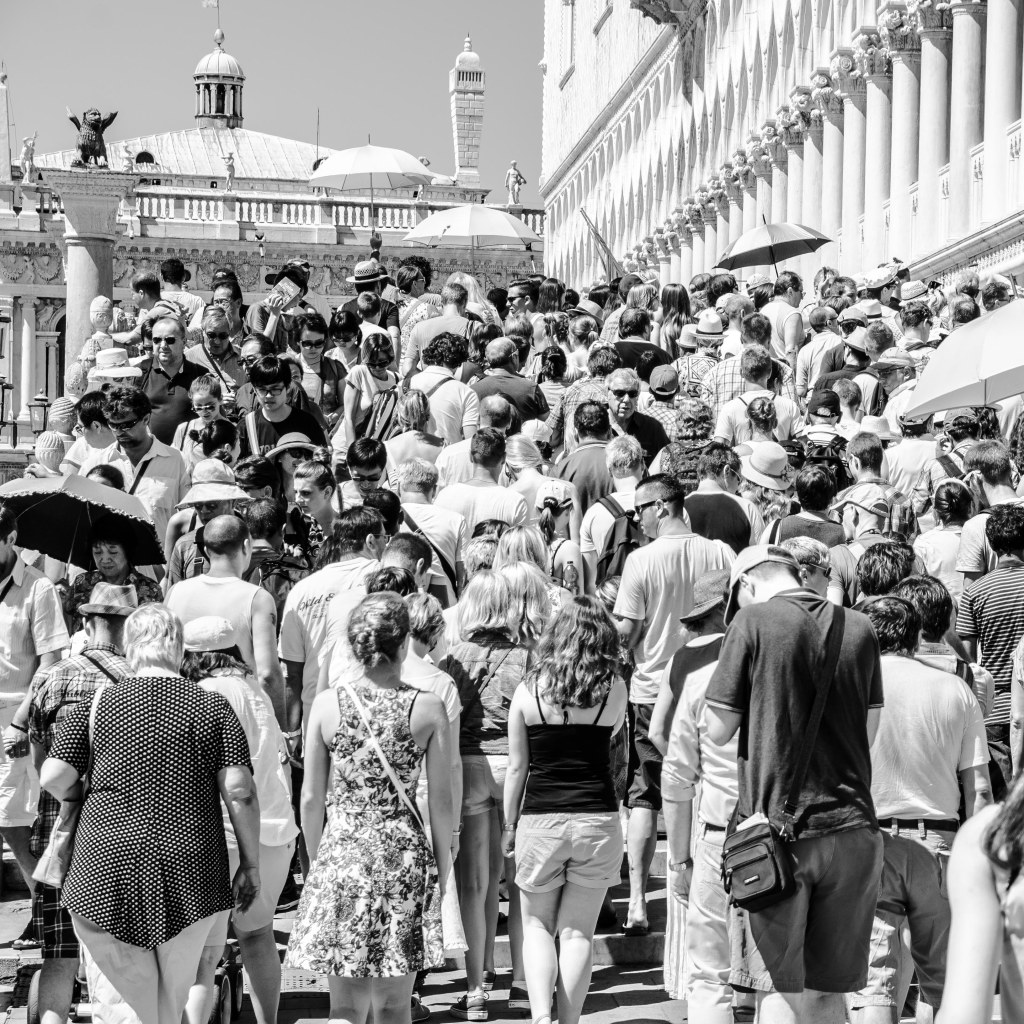
Most of the visitors to Venice come on day trips in their throngs and treat it as a tick box exercise. St Marks square – tick! Rialto Bridge – tick! Doge Palace – tick! As I approached this bridge I was stunned by the amount of tourists crossing so close to each other like lines of marching ants on a mission. So much so that a giant could observe these people in the same way as we do the ants and wonder what drives them to act together in this way. The lack of interaction only added to the insectoid nature.
A small aperture was used to compress and flatten perspective and provide depth of focus. It’s difficult to tell there are steps as they are mostly hidden so it may take a second before you realise these people are on a bridge. I had thought of cropping out the buildings and it does make it more claustrophobic but I wanted to also convey the sense of purpose these people have and I believe the buildings represent that; as to many people it will be recognisable as Venice and show these people as tourists on a mission. I also think the buildings add another layer of comparisons and relationships – a packed bridge is being mocked by a statue with it’s arms flung open as if to say ‘hey you lot! go away!’ or the domed white buildings relationship with the open white umbrellas for example. I chose B&W primarily to avoid the confusion of colour which I found too distracting on the people’s clothing but when converted adds far greater tonal range and interest to the image. I think the contrast between the top third and the bottom two thirds of the picture works better in B&W too and avoids the image being overly busy and adds an element of structure.
Although it’s divided roughly along the rule of thirds it’s up to you where to go – do you want to follow this crowd? There is no focal point in this image but you may find one. I am following the code of Bazin :-
‘For him, the incalculable virtue of deep focus is its ambiguity. Since everything in the film frame can be seen with equal clarity, the audience has to decide for itself what is meaningful or interesting’ (Bazin and Cardullo, 2011)
I thought it was comical when I took it – especially the guy on the right of centre in sunglasses who refuses to go with the masses but looking at it now in a time of lockdown and social distancing it makes me feel uneasy especially with Northern Italy being hit so hard – when will the normality of crowds actually feel normal again?
Reflection
Having looked at my ‘body of work’ or as I put it 60000 images of holidays and other crap I realised that my experimentation with shallow focus was limited to some portrait shots with a 1.4 lens I once owned and not much else. I do remember taking a beautiful image of a buttercup with a macro which by default always has shallow focus but can’t find the bloody thing. Anyway I was drawn to the work of Mona Kuhn who is used as an example in the EYV book and was mesmerised by one of her images in particular….
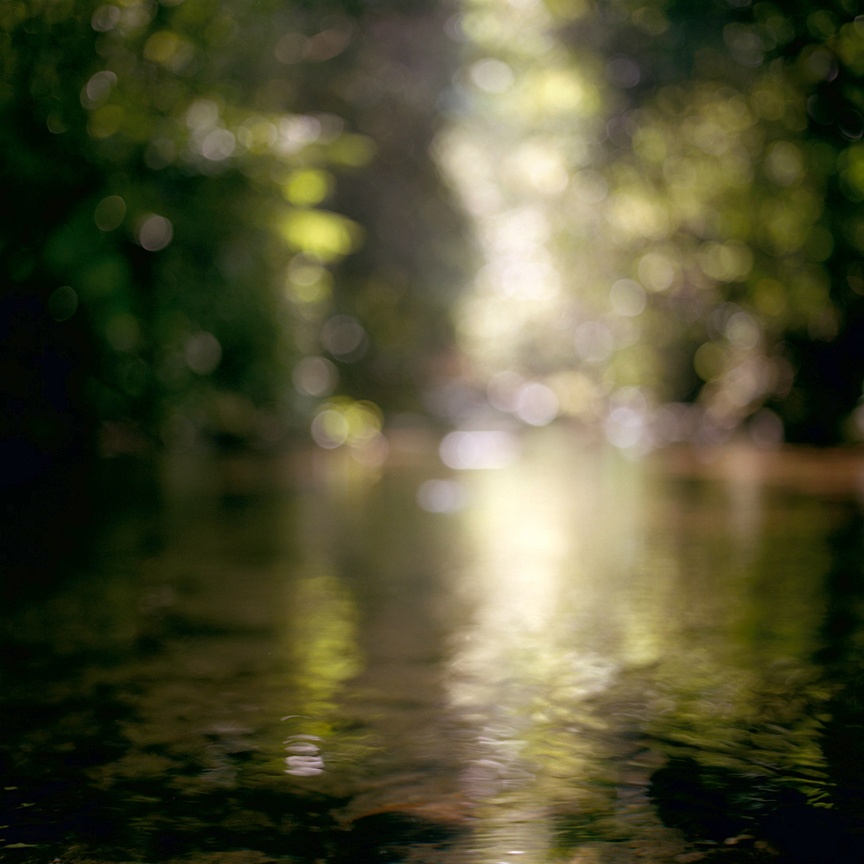
Even the tiny sliver of focus at the bottom of the image shows movement and therefore gives the image a sense of having no focus point at all which to me looks almost ethereal. If I ever feel down in future I’ll look at this and see the gentle flowing water, feel the sun and listen to the bird song.
I went out and tried a shallow focus technique with a 1.8 50mm lens.
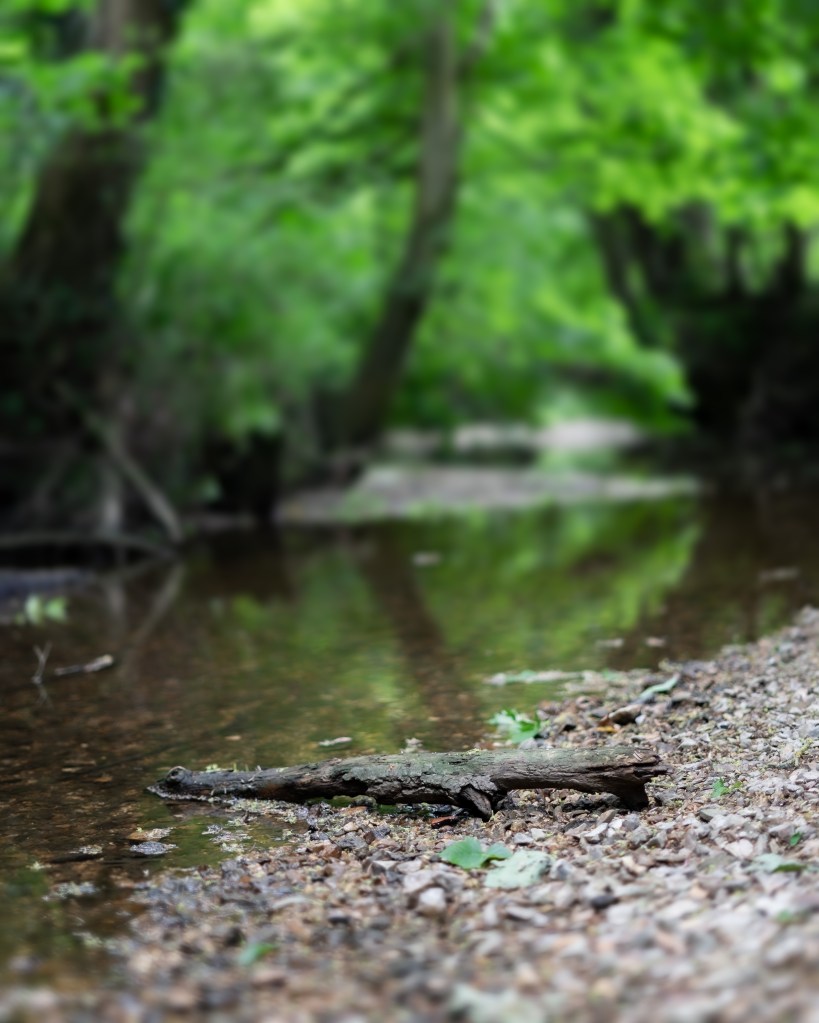
This image doesn’t work because a) it’s a stick Lee who cares (if it was a shopping trolley then you are saying something!) and b) the out of focus areas have no bokeh.
In truth the 1.8 lens wasn’t enough to give a shallow depth of field from where I took the picture so I attempted to add it in photoshop and it’s not worked. But the point isn’t that I wanted to take the same picture the point is I just wanted to illustrate my need to revisit this in other course work.
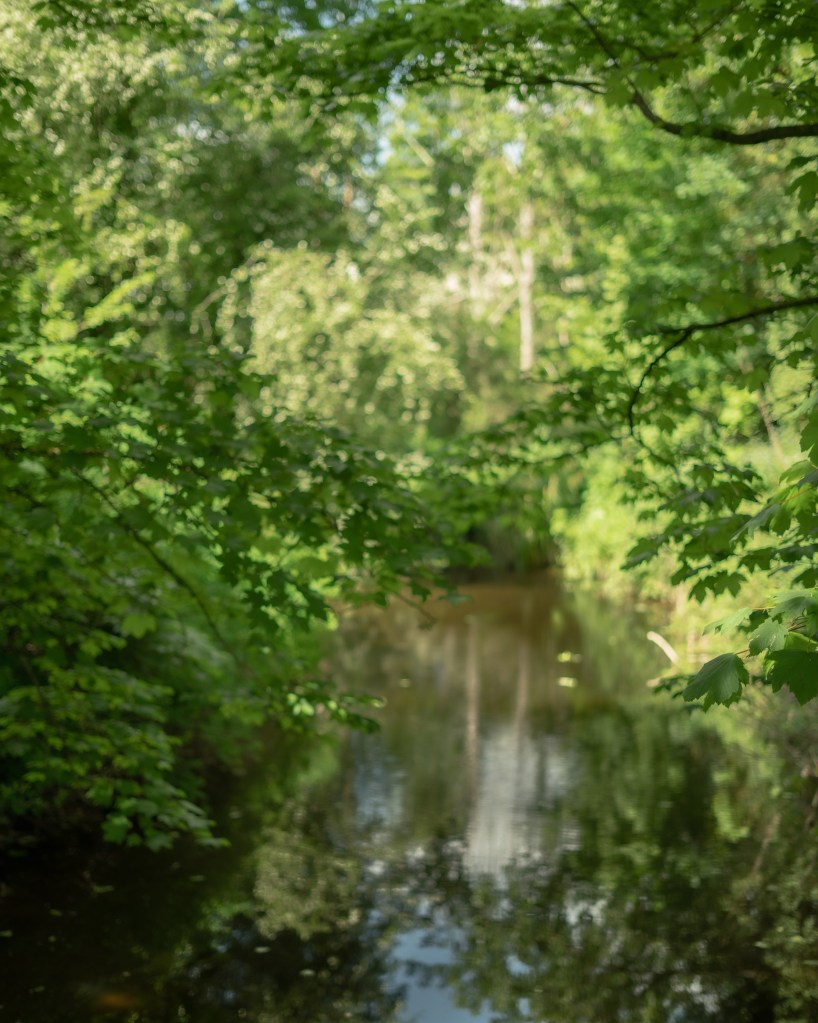
I tried another with just the leaves of the outer part of the right hand frame in focus – I find it more interesting but again it’s too in focus. I’ll try again, again.
Bibliography
Live! From Library: Group f.64 & Revolutionizing American Photography – YouTube [WWW Document], n.d. URL https://www.youtube.com/watch?v=wquPXd5OHe0 (accessed 5.11.20).
Mona Kuhn – YouTube [WWW Document], n.d. URL https://www.youtube.com/watch?v=088__mSx_0k (accessed 5.11.20).
Photography Secrets of Edward Weston’s Darkroom – YouTube [WWW Document], n.d. URL https://www.youtube.com/watch?v=yT2-xpKBafs (accessed 5.12.20).
Secrets of Edward Weston’s Photography – YouTube [WWW Document], n.d. URL https://www.youtube.com/watch?v=bUAKoiRhLR8 (accessed 5.12.20).
André Kertész, 2020. . Wikipedia. Bazin, A., Cardullo, B., 2011. André Bazin and Italian Neorealism. A&C Black. Blind – Guido Guidi: In-between in Italy [WWW Document], n.d. URL https://www.blind-magazine.com/en/stories/746/Guido-Guidi-In-Between-In-Italy (accessed 5.6.20).
Diffraction Limited Photography: Pixel Size, Aperture and Airy Disks [WWW Document], n.d. URL https://www.cambridgeincolour.com/tutorials/diffraction-photography.htm (accessed 5.6.20).
Divining the real: the leaps of faith in André Bazin’s film criticism | Sight & Sound [WWW Document], n.d. . British Film Institute. URL https://www.bfi.org.uk/news-opinion/sight-sound-magazine/features/andre-bazin-divining-real-film-criticism-overview (accessed 5.11.20a).
f64 Group and the Western View Through the Lens [WWW Document], n.d. . Widewalls. URL https://www.widewalls.ch/f64-group-photography/ (accessed 5.6.20).
Fagon, O.J., 2015. How Ansel Adams and the Photography Group f/64 Found “Pure” Photography [WWW Document]. Artsy. URL https://www.artsy.net/article/theartgenomeproject-how-ansel-adams-and-the-photography-group (accessed 5.10.20).
Group f/64, 2020. . Wikipedia. Group f/64 Manifesto (1932), Alfred Stieglitz (1864-1946): photography and modernity, n.d. . Post-photography. URL http://photographyhistory.blogspot.com/2016/01/post-photography.html (accessed 5.12.20).
Higgins, C., 2018a. Guido Guidi: “Many times I’m not looking when I press the shutter.” The Guardian. Higgins, C., 2018b. Guido Guidi: “Many times I’m not looking when I press the shutter.” The Guardian. Hostetler, A.L., n.d. Group f/64 | Essay | The Metropolitan Museum of Art | Heilbrunn Timeline of Art History [WWW Document]. The Met’s Heilbrunn Timeline of Art History. URL https://www.metmuseum.org/toah/hd/f64/hd_f64.htm (accessed 5.12.20a).
Hostetler, A.L., n.d. Group f/64 | Essay | The Metropolitan Museum of Art | Heilbrunn Timeline of Art History [WWW Document]. The Met’s Heilbrunn Timeline of Art History. URL https://www.metmuseum.org/toah/hd/f64/hd_f64.htm (accessed 5.13.20b).
MONA KUHN [WWW Document], n.d. URL https://www.monakuhn.com/ (accessed 5.6.20)
Pepper No. 30, 2019. . Wikipedia. Pictorialism Movement Overview [WWW Document], n.d. . The Art Story. URL https://www.theartstory.org/movement/pictorialism/ (accessed 5.6.20).
Sheff, D., 1983. Playboy Interview: Ansel Adams. Snapshot, n.d.
Stephen Shore A-Z [WWW Document], 2017. .
David Campany. URL https://davidcampany.com/stephen-shore-z/ (accessed 5.7.20).
Text – Unconcerned But Not Indifferent [WWW Document], n.d. . Broomberg & Chanarin. URL http://www.broombergchanarin.com/text-unconcerned-but-not-indifferent (accessed 5.12.20).
Wikiquote [WWW Document], n.d. URL https://en.wikiquote.org/wiki/Main_Page (accessed 5.12.20).
http://www.gianluca-cosci.com [WWW Document], n.d. . gianluca-cosci. URL https://www.gianluca-cosci.com (accessed 5.6.20).
 Lee Abbey OCA Photography Degree