There has always been something magical for me about the ability to capture ‘freeze frame’ images. I remember seeing some of Edgerton’s work as a kid and being amazed – bullets through cards, apples etc – all stayed with me and stored in a dark compartment of my mind – now dusted down, reopened and examined like a personal time capsule.
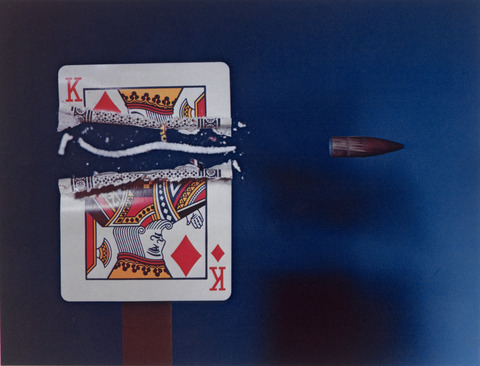
available at Yale University Art Gallery
But we will come back to Edgerton and my foolish attempt to recreate some of his magic later. Firstly we must start at the beginning at a street corner in Paris with the innocent act of a shoe shine.
The first known image of a person in a photograph was taken in 1839 by Louis Daguerre creator of the Daguerreotype. This tiny 6.5″ plate has been the subject of much analysis as to just how many people are captured in this shot and whether it was staged or not. I found one interesting analysis here. What is just as interesting is what it doesn’t capture. The fact the shutter had to be open for a long time in the early days of photography due to the crude lens – perhaps as long as an hour – meant that the hustle and bustle of a busy city corner remains for the most part hidden. Uncaptured and unfrozen. Busy streets look empty.
Rapid improvements in the development process together with new and improved lenses (thanks to Voigtlander – a name still recognisable today and a company operating before photography) meant that images could be captured 90% faster (Clarke, 1997). It would however take another 38 years and some ingenuity from Eadward Muybridge before we saw our first proper ‘freeze frame’ images.
Muybridges horse images proved the theory that a horse when running took all feet off the ground but not perhaps how people expected. In pretty much all imagery of horses from prehistoric cave paintings to the Bayeaux Tapestry to 19th century oils a strident horse with all legs off the ground was pictured like this…
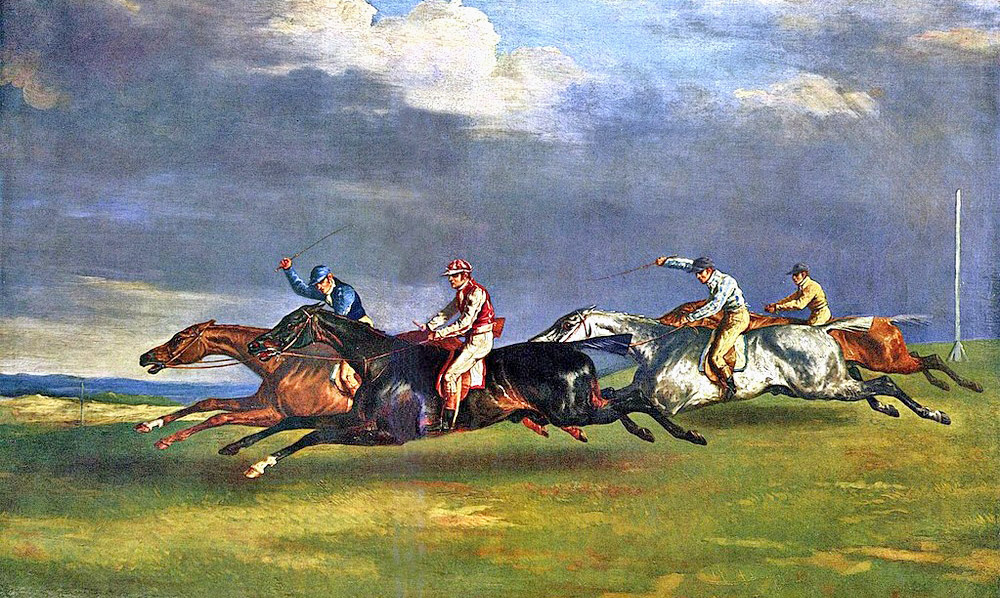
available at https://en.wikipedia.org/wiki/The_1821_Derby_at_Epsom
Muybridge’s set up of 12 cameras each fired as the horse broke the electrical connector placed across the track resulting in twelve still images that when put together showed that infact a horses feet were off the ground when underneath the horse…

available at https://www.smithsonianmag.com/smithsonian-institution/how-19th-century-photographer-first-gif-galloping-horse-180970990/
The breakthrough is that the camera can see things that the human eye can’t see, and that we can use photography to access our world beyond what we know it to be – (Perich, Smithsonian Magazine 2018)
Early high speed photography was more about science and perhaps rightly so – within ten years of Muybridge’s efforts photography was able to capture a bullet in motion and by 1908 A M Worthington was taking photographs of water drops in his book ‘A Study of Splashes’ that precursor Edgerton by 30 years.
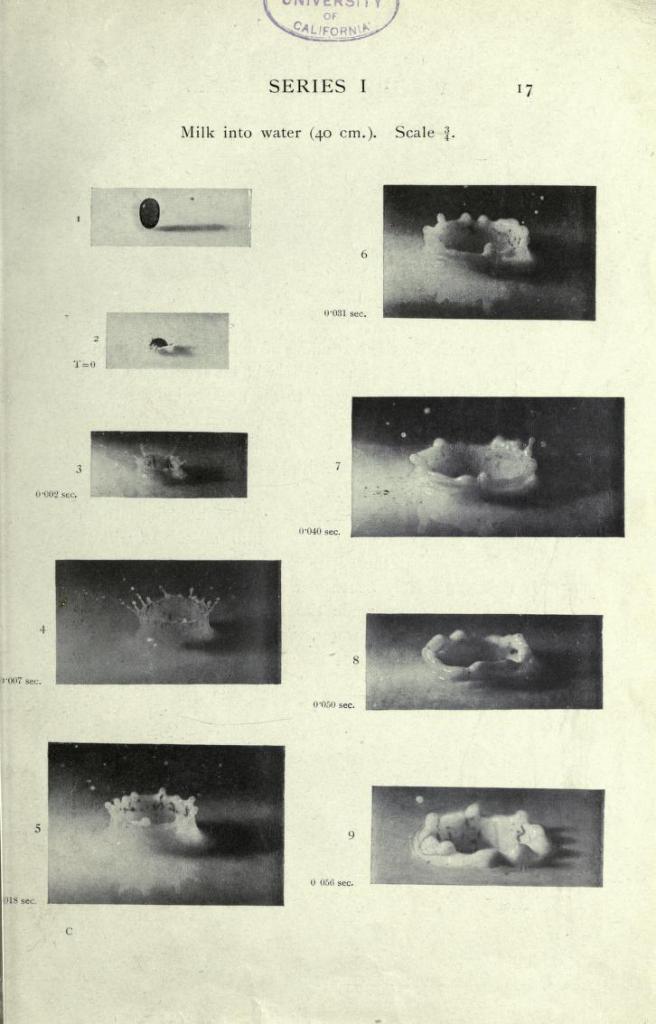
It was Edgerton however who realised that the images he was making were more than just scientific experiments – they were beautiful in their own right. An incidental beauty that was a product of invention and science. He wouldn’t dare call himself an artist – “I am after the facts. Only the facts!” but there is no way a man would spend years experimenting, photographing and refining technique without having an aesthetic value of his own images and continuing until he made something meaningful and artistic.

Available at http://100photos.time.com/photos/harold-edgerton-milk-drop
I’m afraid that try as I might I cannot take to Jeff Wall’s ‘Milk’ image. I can understand why it has been referenced – the milk is frozen in time echoing the Edgerton image above BUT I find it dull and unappealing to look at. Maybe the chaotic splash of milk is deliberately set against the ordered brick work as a juxtaposition. Maybe the tension in the guy on the floor means something, he doesn’t look like a beggar? perhaps his milk is bad? I don’t care to be honest. Perhaps by me questioning what’s going on the photographer has succeeded and I should shut up.
I have spoken about Philip-Lorca DiCorcia and his ‘Heads’ images in a previous post. Instead I will discuss another image in relation to Szarkowski’s thought on time in photography. Does the camera capture time or does it fragment it? Does it isolate thin slices to reveal something new?
The truth is it captures both and in doing so creates a single piece of historical information. Not necessarily historical in importance but historical in that it now becomes the past. If you think back to the very first exercise we did to capture the information on the histogram you’ll remember almost imperceptible changes being visible in the histogram that perhaps were not easily visible in the image itself – time is often imperceptible to us when taken in fractions of a second.
The Saigon Execution image by Eddie Adams in 1968 is still a haunting image to look at 50 years after it was taken and can easily be misread – something that the photographer alluded to when he said “Two people died in that photograph. The general killed the viet cong. I killed the general with my camera” (Adams 1998). The point is that this image both captured time and isolated it at the rawest most devastating moment and asked us to look and decide – what do I reveal to you? It was shown all around the world and would be seen as a symbol for the whole war and the growing sentiment against it. I wonder if this happened today if the image would have the same affect? In today’s world we would be far more likely to see a dozen outstretched arms of passersby videoing footage rather than photographing it and it would be this footage which makes the news not the photographs. Incidentally the footage of the Saigon Execution was also captured on video which is obviously far more graphic but it’s the single still fragment that is famous and known throughout the world – possibly because we aren’t sure who is ‘good’ and who is ‘bad’ in this image, possibly because of the obvious shock value but more likely because it is that final split second between life and death that we are staring at. It gives the viewer a moment to ponder, reflect and to step on the edge of the abyss between light and eternal dark and consider a life in a fragment of time.
Image deliberately not included.
On a lighter note…
Before I show my pictures I wanted to share one video from the Slo Mo guys – I’ve watched many of their high speed videos and find them fascinating but this one tops them all. Videoing light itself at 10 trillion frames per second. You simply cannot freeze motion any quicker than this!!
As I mentioned before in a previous blog I decided to try my hand at water droplet photography to see how difficult it would be – in essence (and only discovered by me after many images) it’s the flash that freezes the image and not the shutter. If the room is dark you can literally set it to BULB and just close it once the flash has fired.
The images below are the result of much trial and error and with very little science applied I’m afraid. The only laboratory equipment I used was a plastic pipette from my daughters chemistry set (which I only bought for her because I never had one as a kid – I don’t think she ever used it).
All timing of water drops and firing of flash was manual and by eye though I did use a remote release shutter which helped (before it went wrong) and then I resorted to manual. The flash was set to it’s lowest power setting (1/128) which means the flash is on/off very quickly enabling the fastest freezing of motion – certainly comparable with technical failures at 1/8000 sec with TTL flash.
I experimented with drops onto solid surfaces (As in the Milk Drop Coronet image) and also into water baths. I tried adding milk which helps with viscosity and drop shapes but a real pro would add xanthan gum – another day maybe.
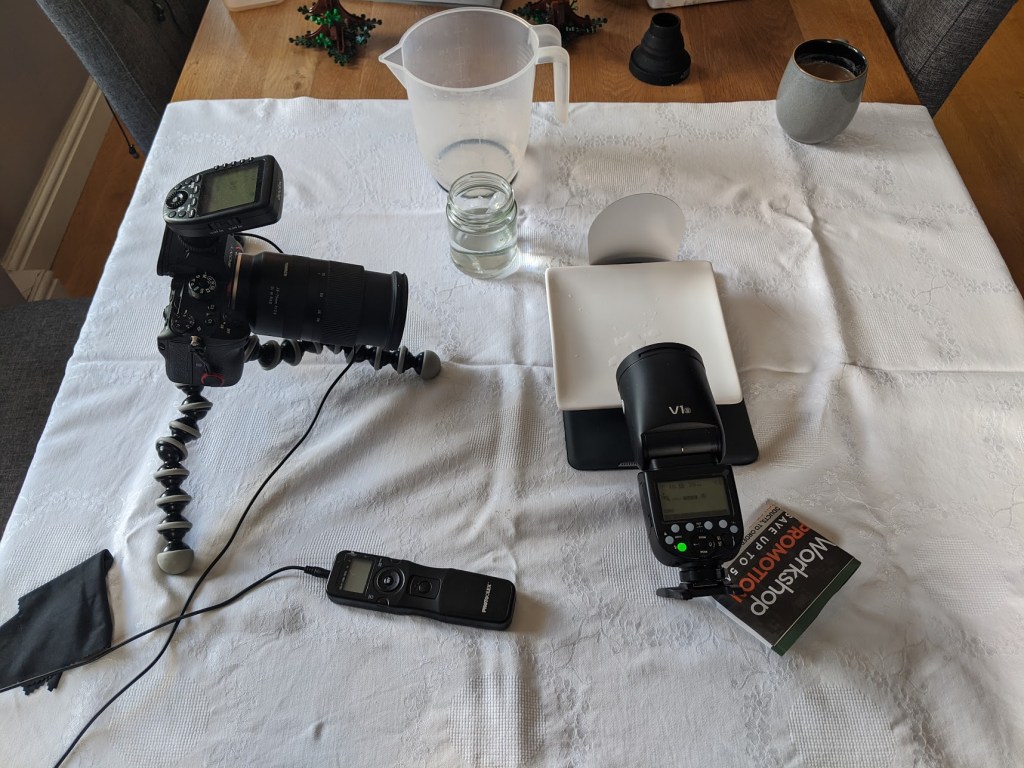
Including the images taken using the incorrect method detailed in my other blog post I took around 3000 images. It didn’t take that long to get useable shots but I kept finding myself going back and trying again and before I knew it there was another 300 to review. It’s addictive stuff.
Significant improvements would have been made had my drops been placed consistently in the same place allowing factors like focus to be accurate for every shot and therefore getting more usable images. A simple lab stand would work which I may well purchase to try again.
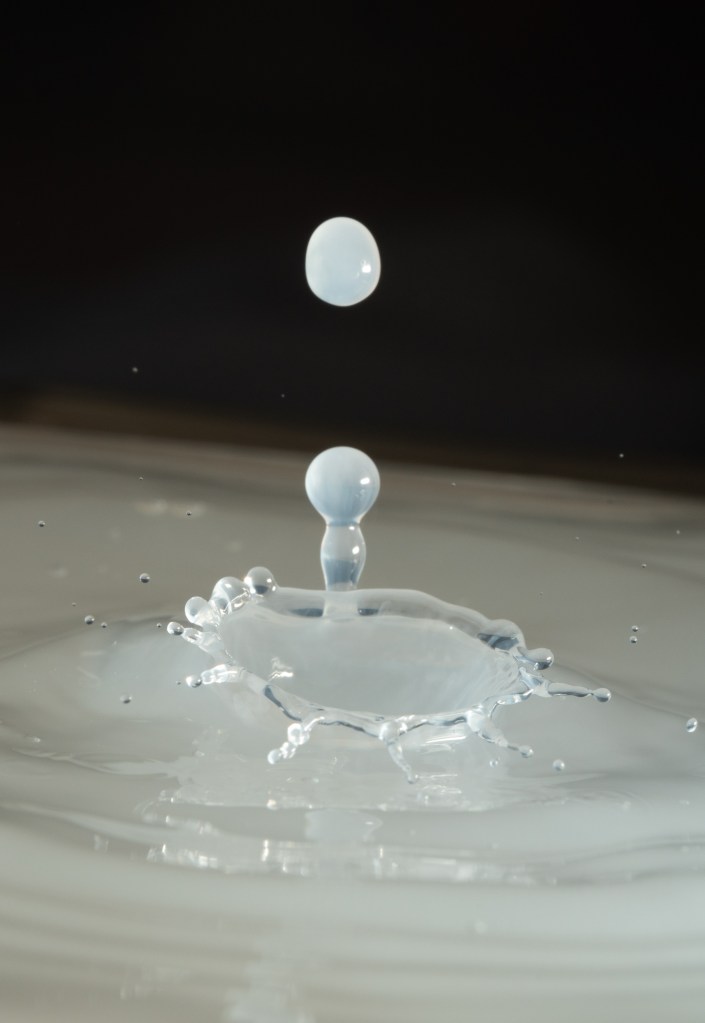
1/250 f/16 ISO400 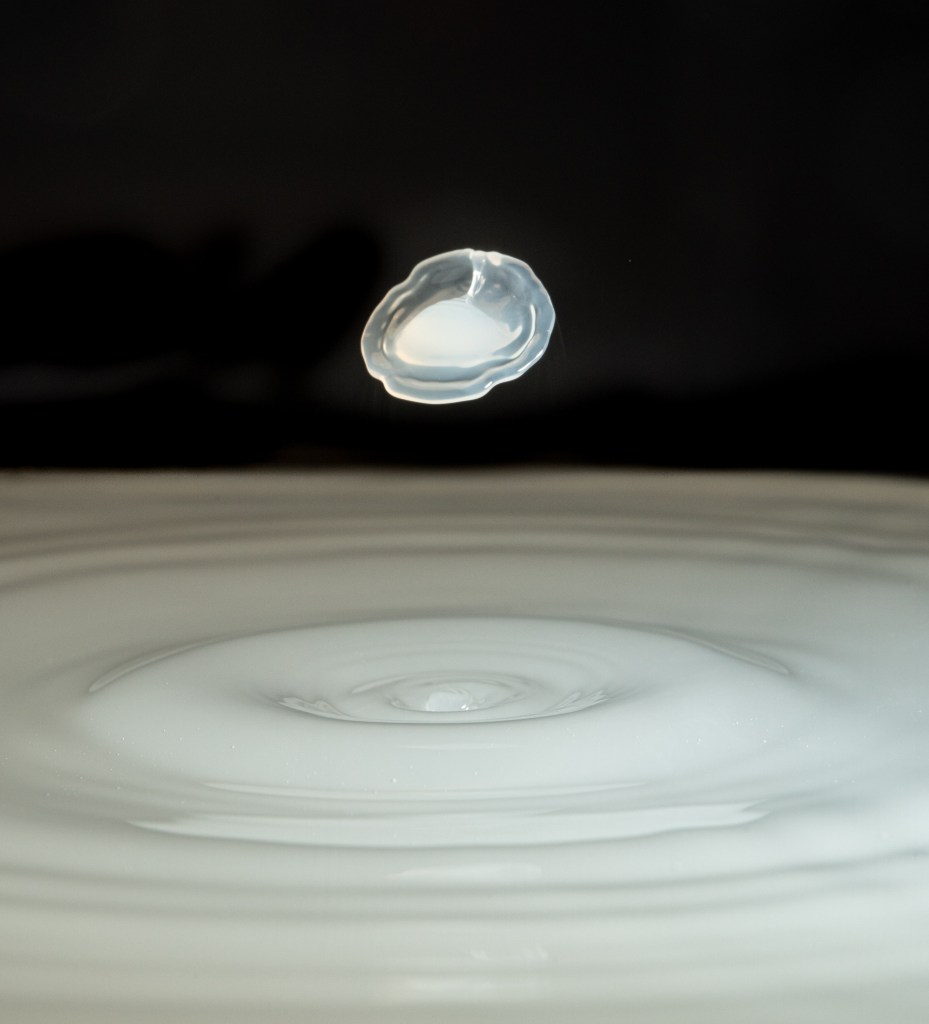
1/250 f/16 ISO 400 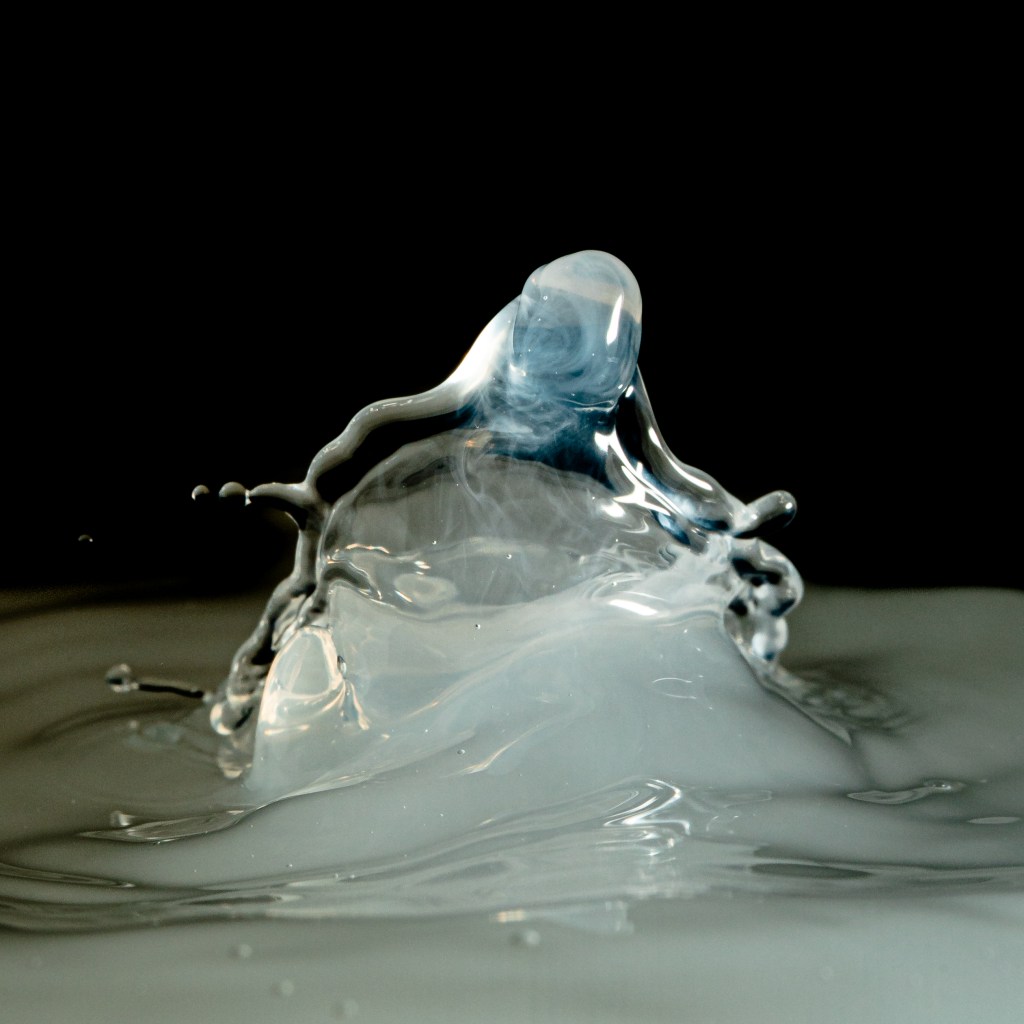
1/250 f/16 ISO 400 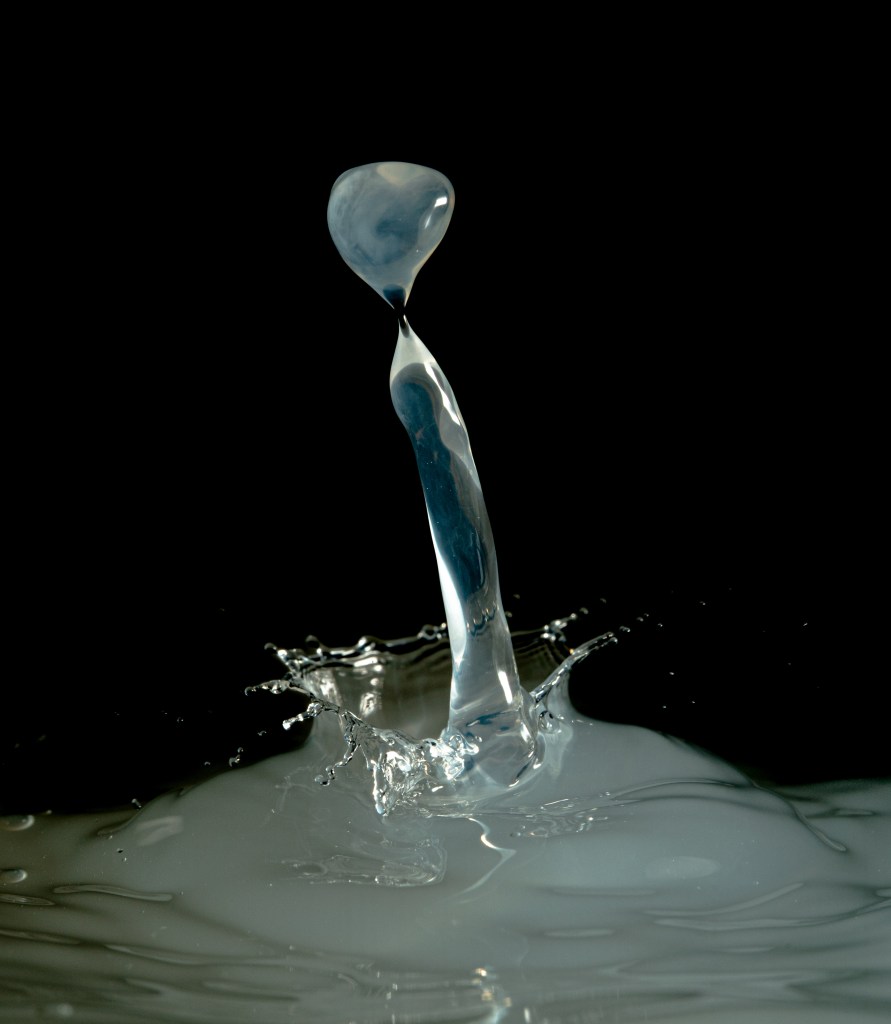
1/250 f/16 ISO 400 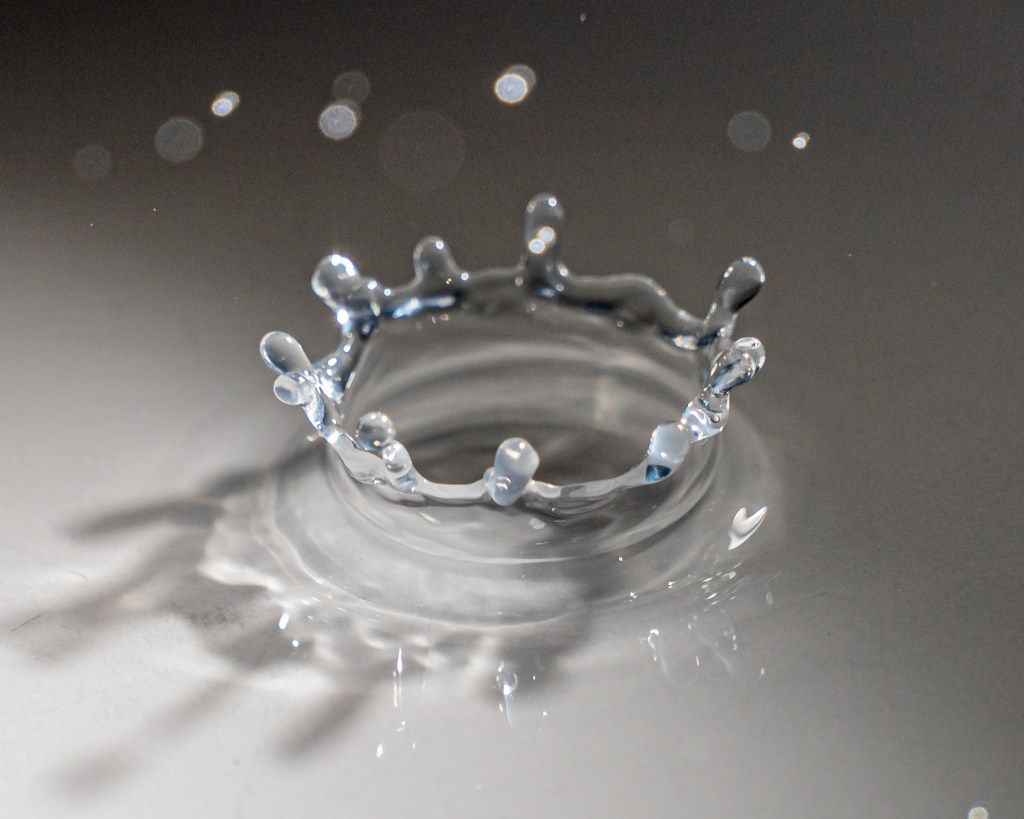
1/8000 f/7.1 ISO 1000
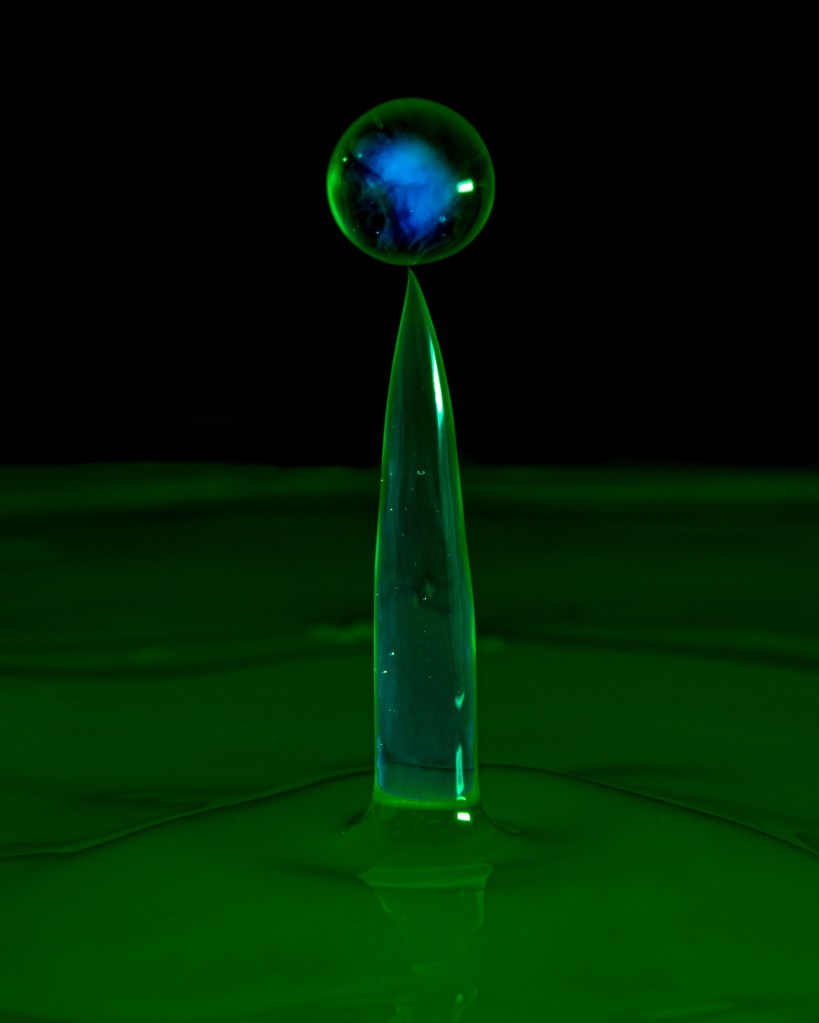
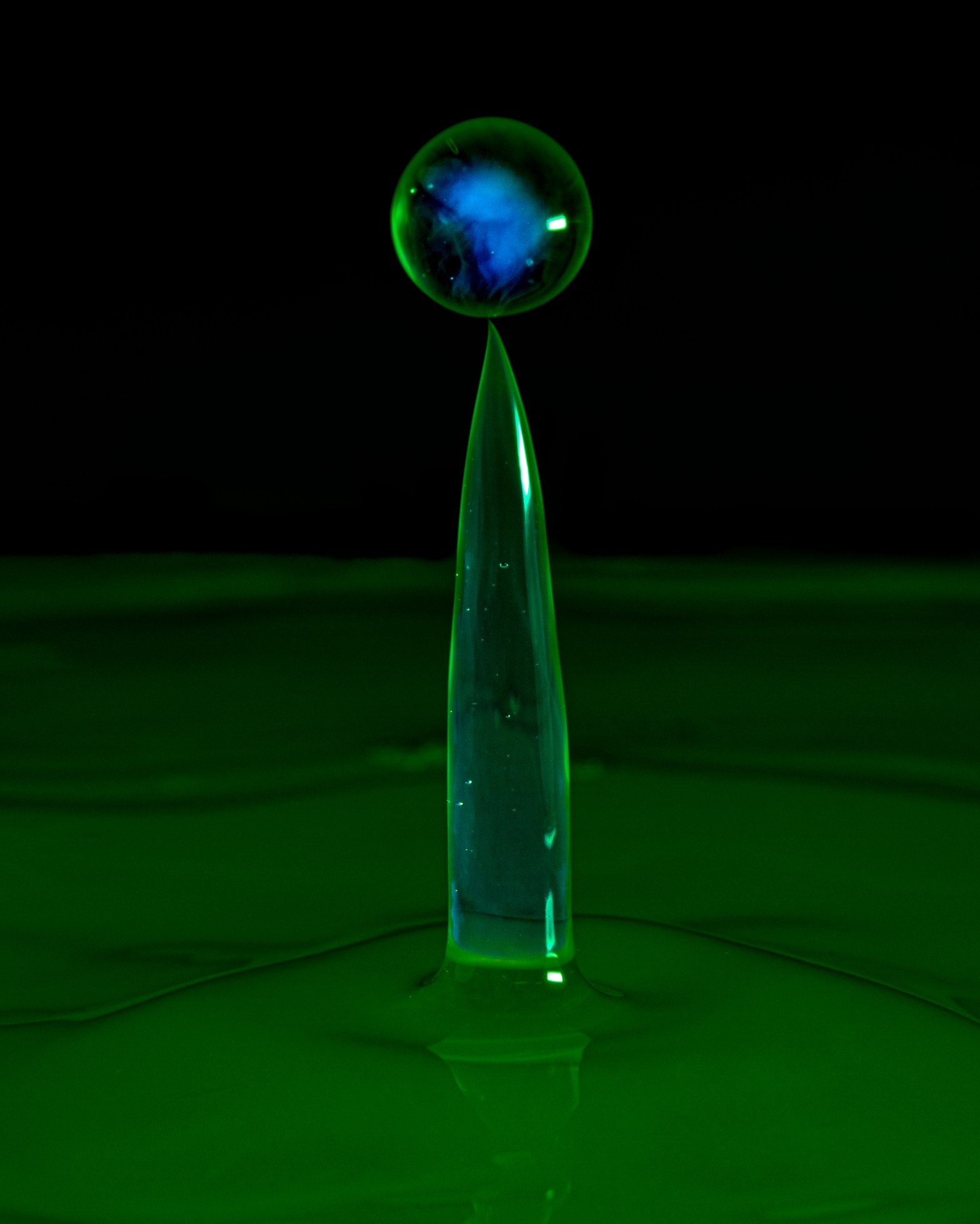
The above image is my favourite – there was a tiny bit of milk added to the water which is what you can see in the droplet at the top and in the worthington jet (the long bit!) I’ve obviously changed colours in lightroom and accentuated the cloudy elements. I’m very happy with the result of this one. Hmmm maybe I’d change the green.
Reflection
I learnt quite a lot about the dynamics of water droplets in this exercise. I found it fascinating and felt like I was channeling Edgerton at some point – conducting photographic experiments at 1am with everyone else asleep in bed.
I never really came close to capturing the beauty of his Milk Drop Coronet but I understand far more about how high speed photography works and will continue experimenting.
I need to consider how and what I read on photography – I now have all the course books but I find myself flitting from book to book. In writing the small piece above I realised that I am not considering the image perhaps as much as I need to. I am beginning to analyse images more – trying to read them. Sometimes I form an opinion quickly but with others – such as ‘Milk’ I struggle. I think I need to seek to understand from the creators why they shoot an image like that. I’m happier knowing what I should feel about it (even if I don’t actually feel it) rather than be left to make up my own mind. Perhaps when I feel more confident about the intentions of an artist it will help me in my own thought processes and therefore my image making.
Bibliography
(10) Secrets of Edward Weston’s Photography – YouTube (s.d.) At: https://www.youtube.com/watch?v=bUAKoiRhLR8 (Accessed 25/05/2020).
1877-1895 A.M. Worthington – ‘The Splash of a Drop’ (s.d.) At: https://www.youtube.com/watch?v=k_g0F_si04A (Accessed 14/05/2020).
Arthur Mason Worthington (2020) In: Wikipedia. At: https://en.wikipedia.org/w/index.php?title=Arthur_Mason_Worthington&oldid=953248118 (Accessed 14/05/2020).
Bullet/Card (probably called Bullet Through King of Diamonds) | Yale University Art Gallery (s.d.) At: https://artgallery.yale.edu/collections/objects/55569 (Accessed 11/06/2020).
Don Giller (2016) Dr. Harold Edgerton on Letterman, February 19, 1985. At: https://www.youtube.com/watch?v=IEUGvwkmR_o (Accessed 16/06/2020).
Eadweard Muybridge (2020) In: Wikipedia. At: https://en.wikipedia.org/w/index.php?title=Eadweard_Muybridge&oldid=955273428 (Accessed 14/05/2020).
EpiphanyVideoworks (2010) Dr. Edgerton and his strobelight. At: https://www.youtube.com/watch?v=SMoIKNZGyf8 (Accessed 10/06/2020).
First photo – the human subject (s.d.) At: https://benbeck.co.uk/firsts/2_The_Human_Subject/photo1h.htm (Accessed 14/05/2020).
Harold Eugene Edgerton (2020) In: Wikipedia. At: https://en.wikipedia.org/w/index.php?title=Harold_Eugene_Edgerton&oldid=955906570 (Accessed 14/05/2020).
History of Art: History of Photography (s.d.) At: http://www.all-art.org/history658_photography13.html (Accessed 14/05/2020a).
History of Art: History of Photography (s.d.) At: http://www.all-art.org/history658_photography13-2.html (Accessed 14/05/2020b).
IMPACT | Philip Lorca diCorcia: Head On (s.d.) At: https://museemagazine.com/features/2019/9/23/impact-philip-lorca-dicorcia-head-on (Accessed 14/05/2020).
Introduction To The Photographers Eye – John Szarkowski (1966) (2010) At: https://tracesofthereal.com/2010/02/21/introduction-to-the-photographers-eye-john-szarkowski-1966/ (Accessed 14/05/2020).
JAN GROOVER (s.d.) At: http://janetbordeninc.com/artist/jan-groover/ (Accessed 14/05/2020).
Jeff Wall | Gagosian (2018) At: https://gagosian.com/artists/jeff-wall/ (Accessed 16/06/2020).
Lubbock, B. T. (2009) ‘Great Works: Dynamism of A Dog on a Leash (1912) Giacomo Balla’ In: The Independent 04/09/2009 At: http://www.independent.co.uk/arts-entertainment/art/great-works/great-works-dynamism-of-a-dog-on-a-leash-1912-giacomo-balla-1781174.html (Accessed 10/06/2020).
Milk Drop Coronet (s.d.) At: https://www.artic.edu/artworks/120885/milk-drop-coronet (Accessed 14/05/2020).
Nicholas Jenkins: traces (s.d.) At: https://web.stanford.edu/~njenkins/archives/2007/08/traces.html (Accessed 14/05/2020).
Niépce and the Invention of Photography (s.d.) At: https://photo-museum.org/niepce-invention-photography/ (Accessed 14/05/2020).
Patowary, K. (2019) The Galloping Horse Problem And The World’s First Motion Picture. At: https://www.amusingplanet.com/2019/06/the-galloping-horse-problem-and-worlds.html (Accessed 15/06/2020).
Philip-Lorca DiCorcia – Exposed at Tate Modern (s.d.) At: https://www.youtube.com/watch?v=bpawWn1nXJo (Accessed 14/05/2020).
PicBusters (2017) Milk Drop Coronet: Dr. Harold Edgerton, the father of Photo & High-Speed Photography | PicBusters. At: https://www.youtube.com/watch?v=8AJ8BdHHBcI (Accessed 16/06/2020).
See How a Single Photo From Vietnam Helped Fuel The Anti-War Movement (s.d.) In: Time At: http://100photos.time.com/photos/eddie-adams-saigon-execution (Accessed 10/06/2020).
See How One Man Revolutionzied High-Speed Photography (s.d.) At: http://100photos.time.com/photos/harold-edgerton-milk-drop (Accessed 14/05/2020).
See How This Gravity Defying Photo Was Created Before Photoshop (s.d.) In: Time At: http://100photos.time.com/photos/philippe-halsman-dali-atomicus (Accessed 10/06/2020).
See The Story Behind The First Mirror-Image Photograph (s.d.) At: http://100photos.time.com/photos/louis-daguerre-boulevard-du-temple (Accessed 14/05/2020).
See The Story Behind The First Photo Ever (s.d.) At: http://100photos.time.com/photos/joseph-niepce-first-photograph-window-le-gras#photograph (Accessed 14/05/2020).
Shah, H. (2018) How a 19th-Century Photographer Made the First ‘GIF’ of a Galloping Horse. At: https://www.smithsonianmag.com/smithsonian-institution/how-19th-century-photographer-first-gif-galloping-horse-180970990/ (Accessed 15/06/2020).
Tate (s.d.) Jeff Wall: room guide, room 3 | Tate. At: https://www.tate.org.uk/whats-on/tate-modern/exhibition/jeff-wall/jeff-wall-room-guide/jeff-wall-room-guide-room-3 (Accessed 10/06/2020).
The Earth Inside a Macro Water Droplet – The Slow Mo Guys (s.d.) At: https://www.youtube.com/watch?v=K4sA4Itrca0 (Accessed 14/05/2020).
The Genius of Photography (2007) (2007) Directed by BBC. At: http://archive.org/details/tGoPhoto (Accessed 14/05/2020).
The Slow Mo Guys (2019) Filming the Speed of Light at 10 Trillion FPS. At: https://www.youtube.com/watch?v=7Ys_yKGNFRQ (Accessed 27/05/2020).
TIME (2016) Milk Drop: Behind Harold ‘Doc’ Edgerton’s Photo & High-Speed Photography | 100 Photos | TIME. At: https://www.youtube.com/watch?v=zOGmwd7kauE (Accessed 10/06/2020).
Wikipedia contributors (2019) The 1821 Derby at Epsom. At: https://en.wikipedia.org/w/index.php?title=The_1821_Derby_at_Epsom&oldid=904413750 (Accessed 16/06/2020).
Wikipedia contributors (2020a) Dynamism of a Dog on a Leash. At: https://en.wikipedia.org/w/index.php?title=Dynamism_of_a_Dog_on_a_Leash&oldid=955799767 (Accessed 10/06/2020).
Wikipedia contributors (2020b) High-speed photography. At: https://en.wikipedia.org/w/index.php?title=High-speed_photography&oldid=962437425 (Accessed 15/06/2020).
Wikipedia contributors (2020c) Schlieren photography. At: https://en.wikipedia.org/w/index.php?title=Schlieren_photography&oldid=949050059 (Accessed 15/06/2020).
Worthington, A. M. (arthur M. and Gerstein – University of Toronto (1895) The splash of a drop. (s.l.): London, S.P.C.K.
Worthington, A. M. (arthur M. and University of California Libraries (1908) A study of splashes. (s.l.): London, New York, Bombay, Calcutta : Longmans, Green, and Co.
BBC News (2018) ‘What happened next to create iconic image’ In: BBC 29/01/2018 At: https://www.bbc.com/news/world-us-canada-42864421 (Accessed 17/06/2020).
 Lee Abbey OCA Photography Degree
I had this starred to look at and forgot, excellent exercise Lee, love the images, really well done!
LikeLike