I ended up as probably most students do on this topic a little bit obsessed with Francesca Woodman. The story of her untimely death at 22 is initially at least a big part of it but the photography speaks for itself. I found myself watching documentaries and serious presentations on the artist but didn’t actually get a sense of her at all. You can look for meaning in her photographs but I’m not sure that’s fair or intended – video clips show a student experimenting and nothing more. You might want there to be meaning because of the tragedy but does it mean there is? Disappearing into the house, becoming an angel. It feels like foreshadowing and it’s an easy to draw conclusions. I prefer to look at the work for what it is and although there’s the back story nagging away at you it’s still possible to enjoy the images and there is no harm taking a little more time to ponder them. I think Gerry Badger needs to explain who he is referring to when making a link between 70’s ‘tradition’ of personalised psychodrama with temporal spatial displacements. He offers no examples and with my limited knowledge I can’t make the same link he has. I do think that using slow shutter for portraiture can impart sinister overtones – in this image for example.
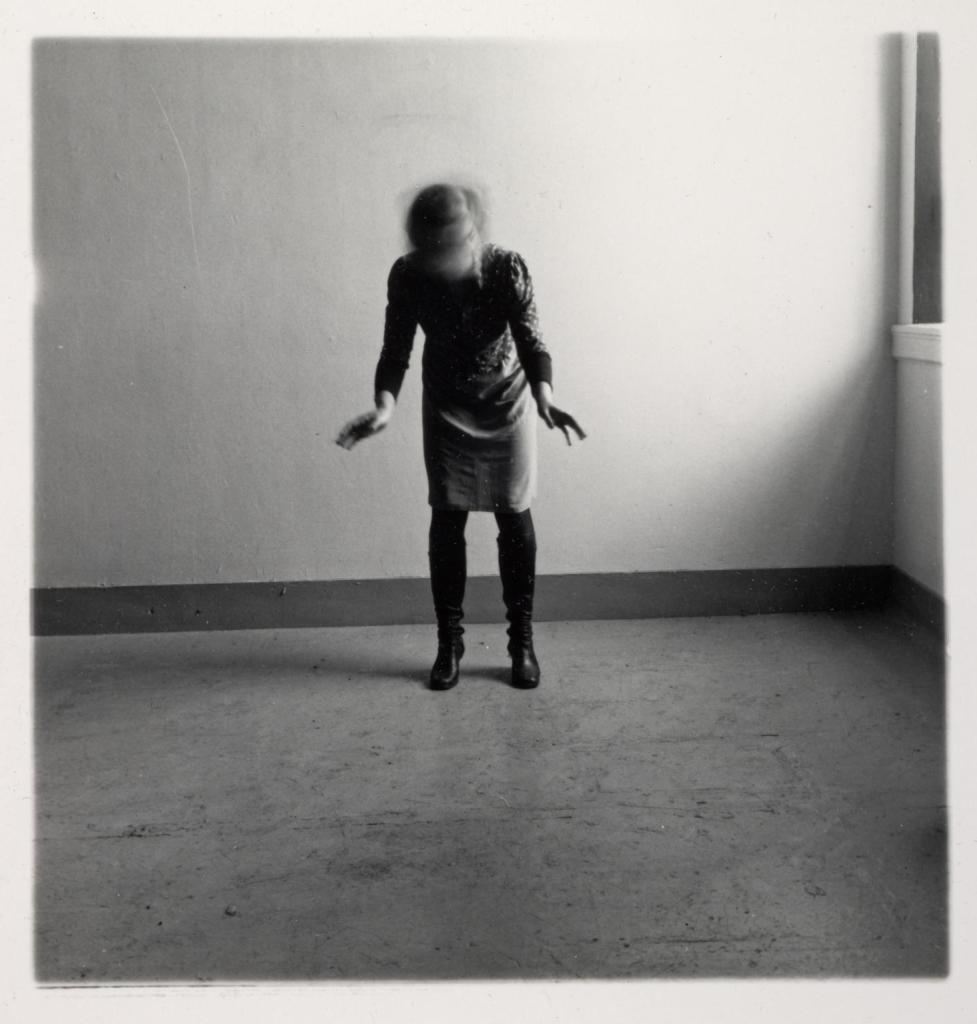
It looks like she is shaking her head as if saying no, her arms are open as if to pick something up or hug someone but there is nobody else in the image. It’s unsettling in a way a ‘still’ image of the same subject would not be.
Long exposure and how it shows time was taking to creative extremes by Micheal Wesely and to a lesser but perhaps more beautiful extent by Hiroshi Sugimoto and his Cinema and Seascape images.
I struggled a little with Michael Weseley – or rather with the idea behind some of his work. For example his five minute portraits. He believes you can’t capture the essence of someone in a normal portrait – but in a five minute portrait you can? I’m not convinced – it tells me less if anything. You can see a selection of them here.
With his ultra long exposures of buildings measured in years the idea is clever and there is something extraordinary about seeing the ordinary seemingly unchanging daily world played out over two years condensed into one image where the changing seasons and even weather are all of a sudden visible via the changing ellipse of the sun on the image (or gaps if the weather has been poor!). So it’s clever and it does make you think for a bit but I found them repetitive and often I wished that the exposure was even longer to get a greater sense of the finished structure of some of the buildings once complete. I also think that scale of the image becomes somehow meaningless to us as we cannot easily comprehend the passing of time even on this relatively short scale therefore the emotional attachment to it is finite, though the emotional reaction or lack of it is probably also down to the subject matter.
I found that I enjoyed his images on a smaller scale – flowers in a vase from fresh to dead captured in one image. Exposure in hours of Monets house in Giverny capturing the famous bridge and the lillies which look as impressionistic as the paintings. These have more personal meaning and therefore are more interesting and perhaps even beautiful to look at.
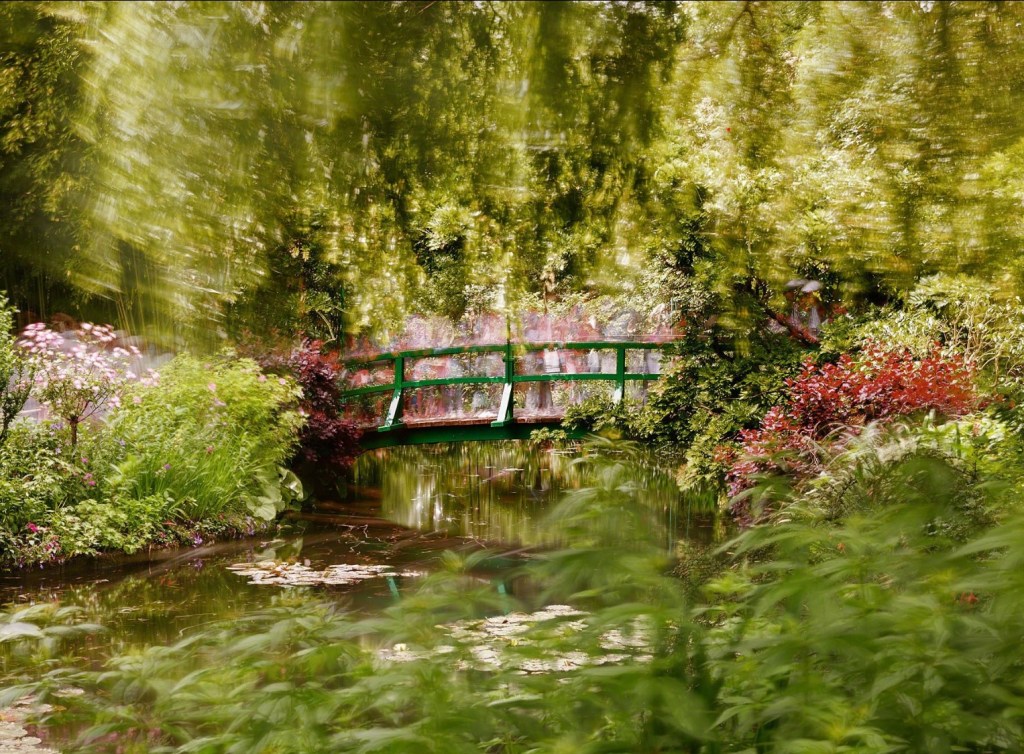
It was becoming clearer to me that the scope for longer exposures in my photography is huge. As I looked at the other artists in this section it seems that slowing the shutter perhaps offers more artistic opportunities than fast shutter which edges more towards the scientific than the artistic. I used slow shutter in my second assignment and really enjoyed the process and I did experiment with even longer shutter speeds for this exercise too but found that noise/artifacts were an issue (i had noise reduction off as to have it on doubled the exposure time) and a delve into the methods used by Wesely showed up secretive homemade cameras based around tiny pinhole apertures that I couldn’t easily replicate.
Referring back to the blur of both Rovert Capa’s D-Day landings and Robert Franks elevator girl as a stylistic choice is different. Different in the sense that a deliberate long exposure on fixed cameras is a premeditated choice whereas the handheld images of Capa and Franks are perhaps blurred by necessity due to the technical limitations, the location and certainly perhaps in Capa’s case his own movement. So while there is a ‘style’ to them I’m not sure it’s a deliberate one. See below the contact sheet for the elevator girl.
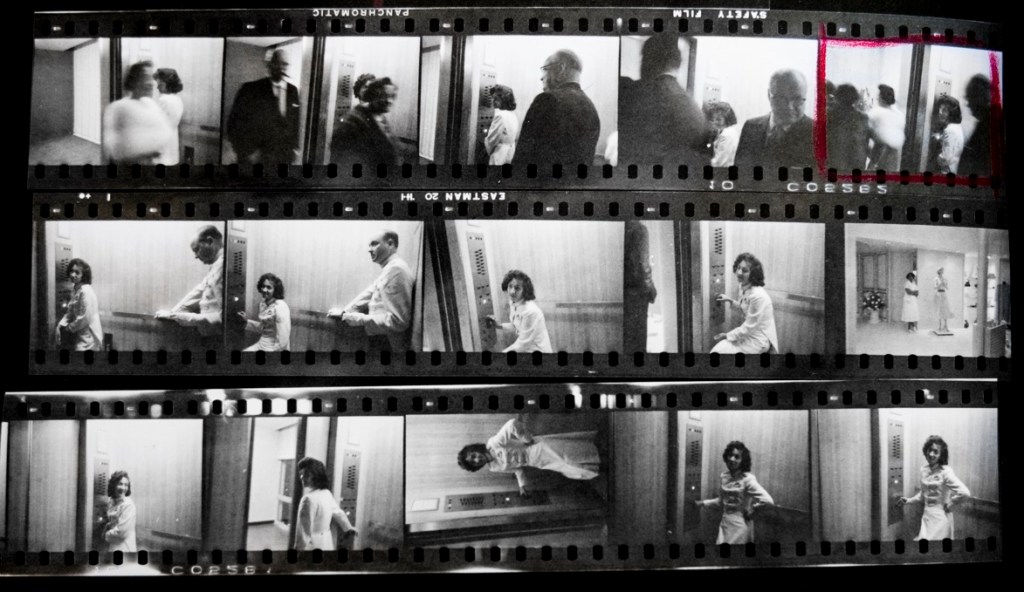
I’m pretty sure working in a relatively dimly lit elevator would require a slow shutter by necessity to get a decent exposure. I take heart from the fact that the rest of the images above are fairly average – a moment of genius out of every fifteen is not a bad strike rate!! The stylistic use of slow shutter / blur can I think be fairly attributed to them even after the event – style surely comes after creation.
Slitscan was not a technique I had heard of before. I did download an app for my phone but was unsuccessful in creating an image worth looking at – I don’t know what I was doing which didn’t help. I looked at the work of Maarten Vanvolsem, Stephen Lawson and as suggested Gareth Davies. Some of these images looked like odd panoramas taken on a phone but others showed movement in an interesting way that although not always successful to me were still interesting as an interpretation of movement that could not be captured in a traditional still frame. I read an article written by Vanvolsem regarding the difficulty of capturing the intricacies of dance with traditional photography where he compared the likes of Lois Greenfield who captures beautiful fast shutter images with the slitscan technique of Stephen Lawson (and indeed himself). See below….
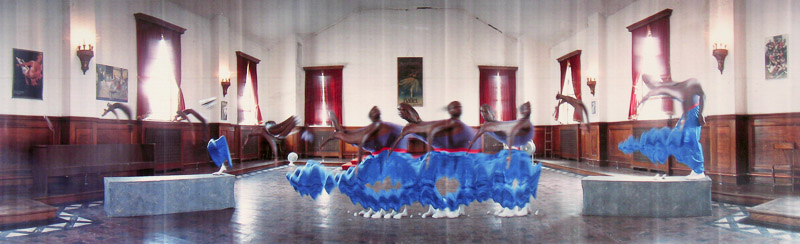
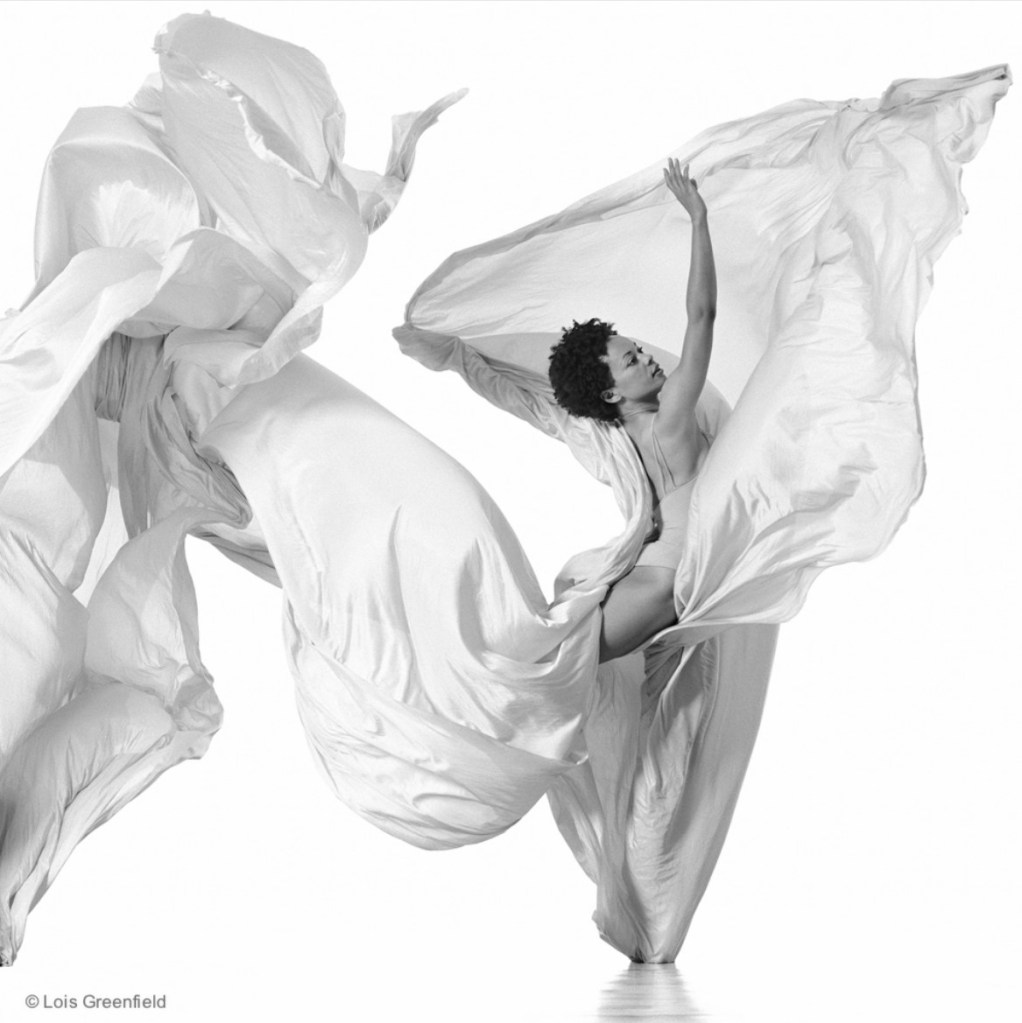
A lot of Greenfields work relies (and look better for it) other materials that the dancer is either holding or that are particles like sand that are being dropped and shaped by the body of the dancer. In some he uses a combination of slower shutter but the above example is more typical. It’s interesting that the material is added as a way to show the viewer that – look, this is movement – the sheet would not be like this otherwise – this dancer is moving! Imagine the same image without the sheet and it could just be a pose. It works and I think some of his images are beautiful. I prefer the work to Lawsons above it but the key differentiator is that Lawsons image not only shows movement – it allows us to track the movement across the image and is perhaps more interesting to look at if not aesthetically beautiful. I found another website that showed the use of a scanner to create a different sense of movement and I tried this technique using my face which you will see in my submission for 3.2. I was really happy with the results.
I have not seen Chungking Express but enjoyed the camera work of the two clips that use what I later learned was a Step Printing effect that not only duplicates frames but also slows the shutter to create the effect.
It was interesting to me how the same effect can create different feelings – the first make you feel edgy and lost as you try to work out what’s happening with everything being stutter and blur whereas the similar technique later in the film in the intimate scene of someone drinking coffee filmed against a moving crowd create a sense of isolation and loneliness.
This video here explains beautifully how the technique is created…
Available at Vimeo via the link above and at https://www.austinschmidt.com/blog-/step-printing-wong-kar-wai
Bibliography
Conley, K. (2013) ‘Francesca Woodman’s Ghostly Interior Maps’ In: Surrealist Ghostliness. (s.l.): University of Nebraska Press. pp.151–178.
Cooke, R. (2014) ‘Searching for the real Francesca Woodman’ In: The Guardian 30/08/2014 At: http://www.theguardian.com/artanddesign/2014/aug/31/searching-for-the-real-francesca-woodman (Accessed 23/06/2020).
D-Day and the Omaha Beach landings • Robert Capa • Magnum Photos (2017) At: https://www.magnumphotos.com/newsroom/conflict/robert-capa-d-day-omaha-beach/ (Accessed 18/06/2020).
danielteolijr (2017) Robert Frank’s elevator girl…Isn’t it wonderful that we have proof sheets to study?. At: https://danielteolijr.wordpress.com/2017/02/14/robert-franks-elevator-girl/ (Accessed 03/07/2020).
Escola da Cidade (2017) Michael Wesely: Fotografias de longuíssima exposição. At: https://www.youtube.com/watch?v=G7ZRrjgARdk (Accessed 18/06/2020).
Gerry Badger » Francesca Woodman (s.d.) At: http://www.gerrybadger.com/francesca-woodman/ (Accessed 02/07/2020).
Gumport, E. (s.d.) The Long Exposure of Francesca Woodman | by Elizabeth Gumport. At: https://www.nybooks.com/daily/2011/01/24/long-exposure-francesca-woodman/ (Accessed 03/07/2020).
Image and Narrative – Article (s.d.) At: http://www.imageandnarrative.be/inarchive/Timeandphotography/vanvolsem.html (Accessed 03/07/2020).
Jordana Lee (2015) The Woodmans [2010] Legendado [PT-BR]. At: https://www.youtube.com/watch?v=5zqNUdtCwkU (Accessed 03/07/2020).
Konoshevich, V. et al. (2020) Time Shows: Ultra-long Exposure in Works of Michael Wesely — Bird In Flight. At: https://birdinflight.com/inspiration/experience/time-shows-ultra-long-exposure-in-works-of-michael-wesely.html (Accessed 18/06/2020).
L.S. Bryan (2009a) Contacts: Hiroshi Sugimoto 1. At: https://www.youtube.com/watch?v=J-jLUSa1MA0 (Accessed 18/06/2020).
L.S. Bryan (2009b) Contacts: Hiroshi Sugimoto 2. At: https://www.youtube.com/watch?v=rY3nGoZqw9U (Accessed 18/06/2020).
Lois Greenfield (s.d.) At: https://www.loisgreenfield.com/ (Accessed 03/07/2020).
Louisiana Channel (2018) Hiroshi Sugimoto Interview: Between Sea and Sky. At: https://www.youtube.com/watch?v=JWh4t67e5GM (Accessed 03/07/2020).
Lumiere » Blog Archive » Stephen Lawson (s.d.) At: https://lumieregallery.net/4368/stephen-lawson-2/ (Accessed 23/06/2020).
Maarten Vanvolsem – Kusseneers Gallery (s.d.) At: http://kusseneerscom.webhosting.be/portfolio_page/maarten-vanvolsem/ (Accessed 23/06/2020).
Michael Wesely – Photography (s.d.) At: https://wesely.org/ (Accessed 18/06/2020).
moonasha (2014) Chungking Express – The Letter. At: https://www.youtube.com/watch?v=veT0Zvjf1lQ (Accessed 27/06/2020).
NPR (2009) ‘Robert Frank’s Elevator Girl Sees Herself Years Later’ In: NPR 30/08/2009 At: https://www.npr.org/2009/08/30/112389032/robert-franks-elevator-girl-sees-herself-years-later (Accessed 18/06/2020).
Panoramic Photography by Gareth Davies (s.d.) At: https://www.tickpan.co.uk/ (Accessed 23/06/2020).
Pollard, N. (2014) ‘Dark Material and Light Writing’ In: Pollard, N. (ed.) Don Paterson. (s.l.): Edinburgh University Press. pp.114–130.
Schmidt, A. (2019) ‘AUSTIN F. SCHMIDT • CINEMATOGRAPHER’ At: https://www.austinschmidt.com/blog-/step-printing-wong-kar-wai (Accessed 27/06/2020).
Tate (s.d.) Francesca Woodman 1958–1981 | Tate. At: https://www.tate.org.uk/art/artists/francesca-woodman-10512 (Accessed 23/06/2020a).
Tate (s.d.) ‘Space2, Providence, Rhode Island’, Francesca Woodman, 1976 | Tate. At: https://www.tate.org.uk/art/artworks/woodman-space-providence-rhode-island-ar00350 (Accessed 23/06/2020b).
Wikipedia contributors (2020) Francesca Woodman. At: https://en.wikipedia.org/w/index.php?title=Francesca_Woodman&oldid=960636869 (Accessed 23/06/2020).
Woodman, F. (1988) ‘Photographs by Francesca Woodman’ In: Frontiers: A Journal of Women Studies 10 (1) pp.50–61.
 Lee Abbey OCA Photography Degree
One thought on “Trace Research”