What seemed fairly clear to me at the beginning of this exercise through sole exposure to HCB as ‘Decisive Moment’ has become jumbled and scrambled and put together in a different way so at the end of this assignment my understanding is improved and enriched but the definition has become more nebulous and obfuscated.
After watching the documentary ‘L’amour de court’ a lifetime of photography is distilled into a phrase early on in the documentary.
‘It’s always luck, nothing else. Luck is all that counts’ – HCB
He is being mischievous ofcourse. He mentions on more than one occasion that geometry and the relationship between objects and also intuition and sensitivity are also key – more so than light.
You can understand the idea of the geometry being key from some of his photographs where he could wait for the decisive moment – and therefore create his own luck.
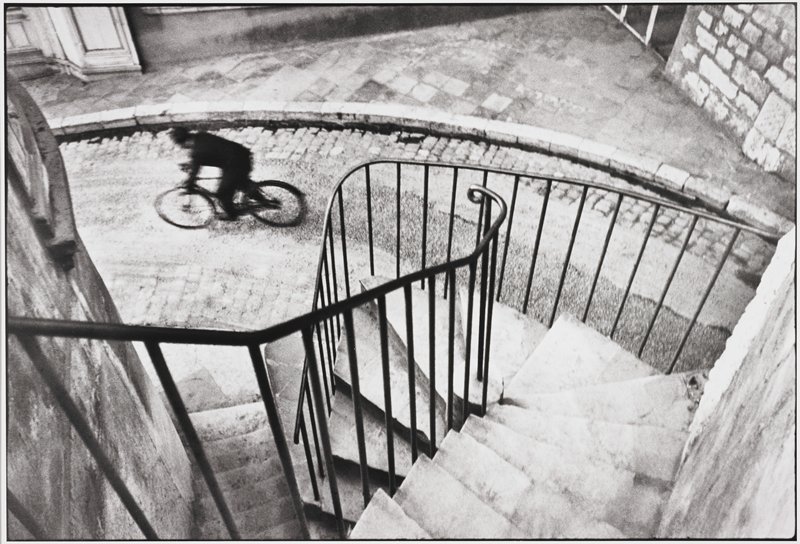
Yes – this is a decisive moment but it’s one of his own creation – this is not luck, this is skillfully recognising the geometry and the composition AND patience. Let the decisive moment come to you!
This is not to say all HCB’s decisive moments are created this way but it is one way – and perhaps it is something to learn from. ‘Composition is in the eye!’ he says. We can emulate by finding the geometry, creating the frame, then waiting. Click.
When his friend Yves Bonnefoy recounts the story of the photo of the children he took on a walk that he hadn’t even really noticed it resonated. ‘When others are distracted, unobservant, Henri is on the lookout, ready to react, not even needing to stop’. This is the essence of my original interpretation of the decisive moment – on the hunt, sniffing out an image, looking for something to happen (not waiting for it!)
By doing this I begin to understand the writing of Zouhair Ghazzal a little. He talks about the nature of the decisive moment as really about people as its the gestures that make the moment, something which is difficult to find in a still life or landscape but then counters that by implying that taken as slices of time and looked at in isolation they can still be looked at as a decisive moment of sorts. There was some rambling which took me four attempts to get to the bottom of but he seemed to be saying that the modern heartless cities are almost devoid of decisive moments because they have lost their humanity.
If I then look at the images from The Present by Paul Graham I can only agree with him! These images are a far cry from the decisive moments of HCB. Colin Pantall in his review points out they are all taken from a middle distance – we are not viewers of something intimate, this is going on all around us everyday and by turning the pages back and forth and comparing the diptychs you look for the differences – you have to because to look at one of the images most of the time is just a reflection of society going about its daily routine and doesn’t show anything – this harks back to Ghazzal and the subway images of Walker Evans which he says merge into one whole away from any individual decisiveness (if indeed there was any to begin with). It really is the decisive moment turned on it’s head and when you look through the book the layout forces you to look at the images in the way the artist intended – going back and forth looking at the differences. It’s like a journey through the mundane, quietly observing a world going on around you but with individual photos needing the support of others to continue that journey.
The images in the The Present are actually reminiscent of Guido Guidi’s work – another youtube video shows his book Veramente online. Some of the images are like little pauses for breath – mundane made beautiful. Details observed that would garner zero attention otherwise (I just re-read this in preparation for assessment and described it in exactly the same way for my assignment 5)
I found the research that followed on from this led me more down the indecisive moment – it started with the washing up images of Washing Up by Nigel Shafran. Banal images that offered sometimes subtle changes of light and order and chaos.
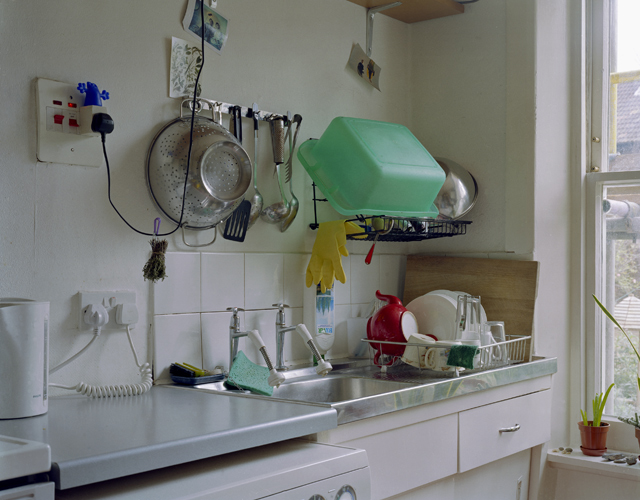
This resonated with me – we spend a LOT of time in the kitchen. We are both keen cooks/bakers and so it’s always a state of flux and from this an idea started to form.
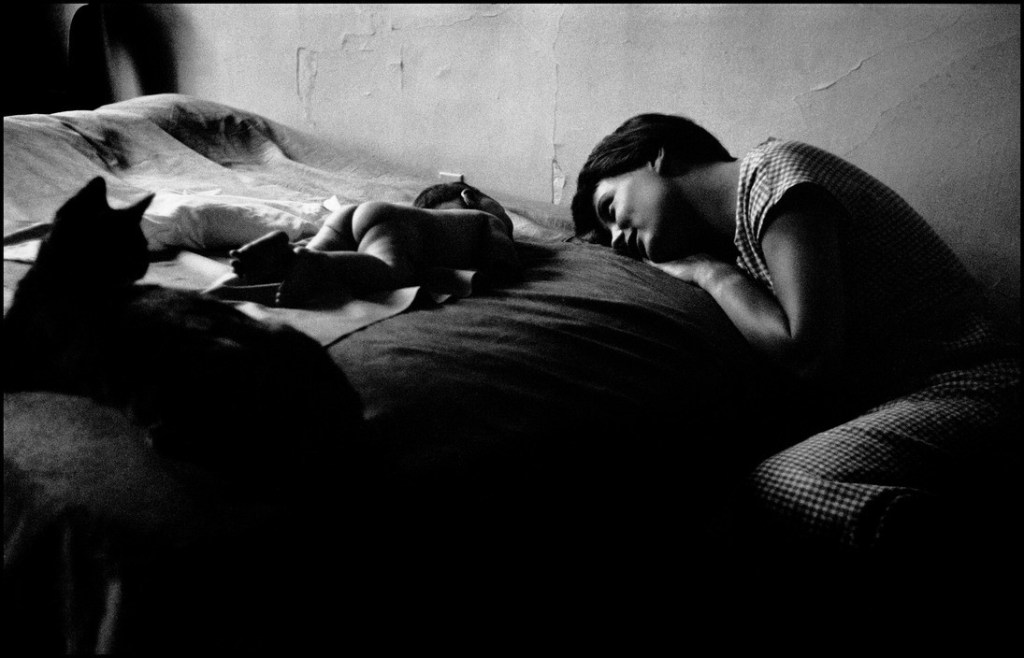
Moving back to more traditional ‘decisive’ was Elliot Erwitt. A slightly more comical take on the decisive moment – especially the dog shots but it was a timeless moment of his wife and child that really grabbed me. Its an image every parent can recollect, a beautiful warm memory embodied in a perfect capture – though having seen a dozen or so prints online I much prefer this darker version. This again makes me think of Ghazzal and a slice of time rather than a traditional decisive moment.
Joel Meyerowitz was another photographer with a similar sensibility as Erwitt but I got the sense that his roving camera wasn’t necessarily looking for a decisive moment but because of luck and time he came across a fair view. You can also see how his photography changed completely with location – frantic city and slow country – the images of Cape Light for example are just beautiful and timeless.
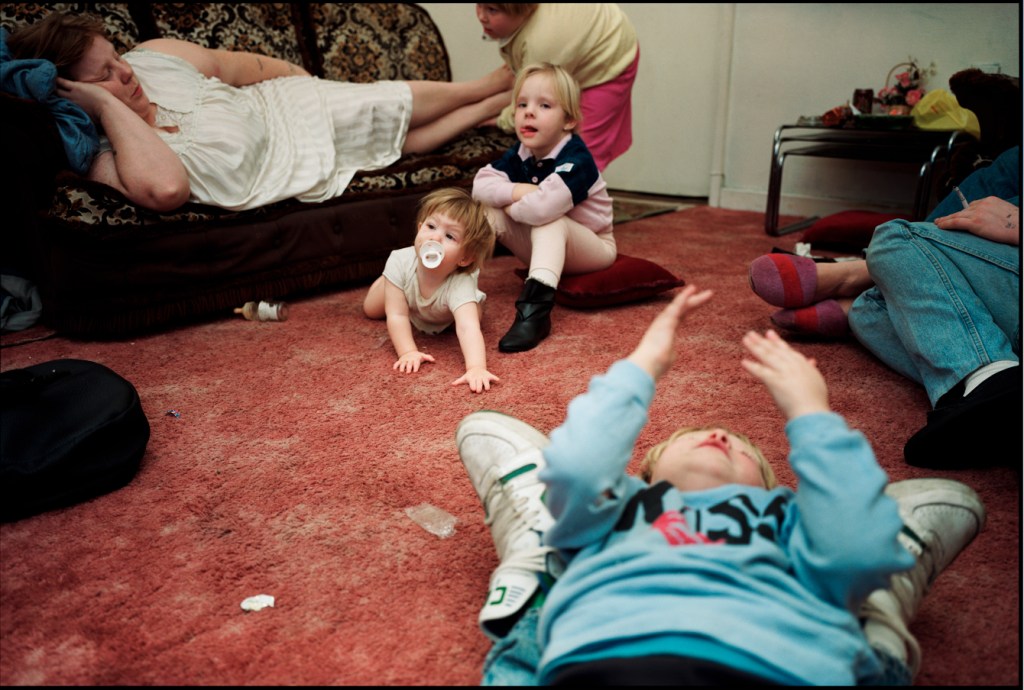
From the beauty of Cape Light to Nick Waplintons – Living Room. These everyday images of working class people in Nottingham getting on with life in some respects more akin to HCBs images. No moment seems decisive in the same way though – it’s like a photographic flyonthewall documentary – slices of life, casual and repeatable events, busy compositions. Time again has played a part and they now look like historical documents. What you see in them is LIFE in big bright colours.
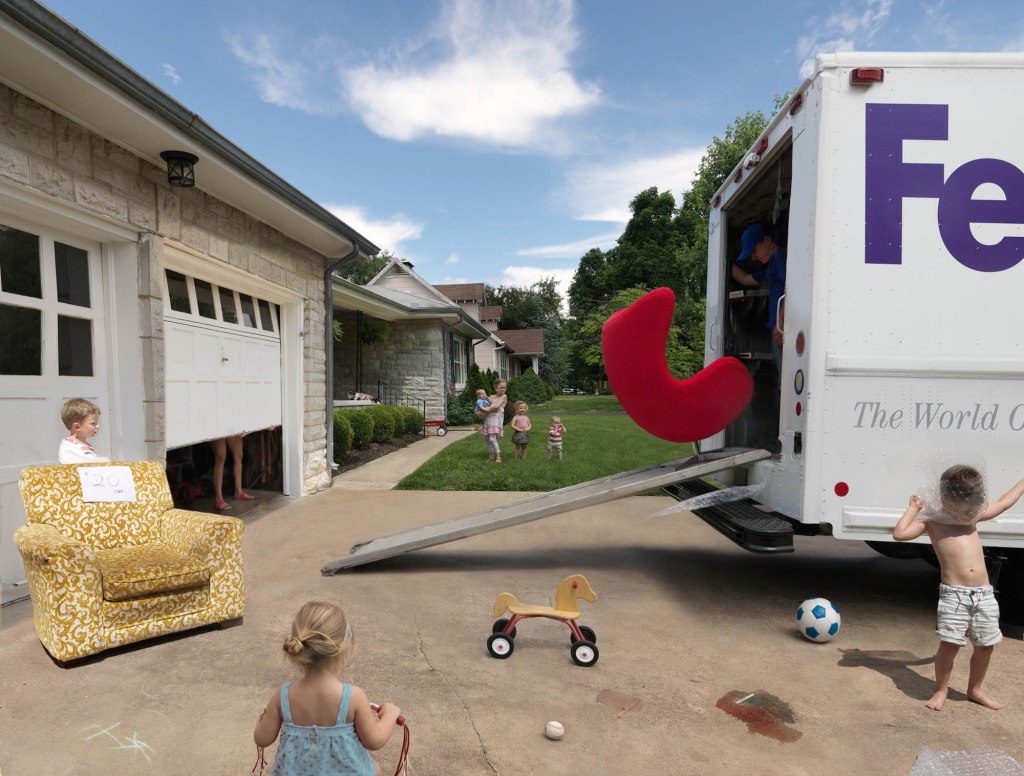
Another artist with a different approach which I loved was Julie Blackmon. Her images look like the everyday mundane until you look a little closer. Something’s not quite right. The image quality and lighting is too perfect to be a snapshot. The compositions look too clever – and then you see the kid playing with the plastic bag on his head and think aaaah! You got me. They are perfectly planned and executed moments – decisively so.
There are other artists that have influenced my images for assignment 3 but I will talk about them in my Assignment post. I don’t think I can summarise better than my introduction except to say that the journey through this path of moments has been difficult to navigate sometimes. Not so much the pictures themselves but more the process of decoding them and understanding them or at least trying to. Either way it’s been fascinating. Cheers.
 Lee Abbey OCA Photography Degree
Good research Lee. I agree that this part does teach yu about actually seeing things and understanding images better. Thorough research – looking forward to seeing your assignment. Cheers and good luck.
LikeLike
Cheers Archna. I definitely feel I got out more than I thought from this assignment – I’m not actually convinced the pictures I’ve used are any good at all BUT that’s almost not the point for me on this one. Its more the idea behind the execution.
LikeLike