Brief
Using the grid display take a good number of shots composing in just a single section – dont bother with the rest of the frame! Evaluate the whole image; is there a visual coalescence, a ‘gestalt’?
Research
There were three threads of research for me here – the first element is covered by my reflection on exercise 1.3 where I looked at how my cropping of the frame can lead to less interesting images so I will cover the other two now. The artists Walker Evans and Alfred Stieglitz and lastly Gestalt theory.
I ended up down the rabbit hole looking at the Stieglitz Equivalents images. Firstly why Equivalents? The description of equivalents in the OCA book determines that any section of the sky is an ‘equivalent’ of any other section. This makes sense at first but the more I looked at the images of Stieglitz the more I became confused. Is any section of the sky equivalent to another part? A few of the images contain the top of a tree or building too so that doesn’t quite add up. Stieglitz wrote in a letter My cloud photographs are equivalents of my most profound life experiences, my basic philosophy of life.(Goldberg, 2003) he was trying to replicate an emotional response in the photographs that would be conveyed to the viewer. I can imagine that a series of cloud images looked at one after another could have a dizzying affect as if craning your head towards the sky over and over again.
Stieglitz I have to say didn’t help with the task at hand. I forgot about the idea of the frame being obvious from the OCA book. I think it’s point was too subtle for me.
Maybe I should spend more time thinking about the ideas given to me rather than trying to understand a different account of a photographers work. Remember that the references in the OCA book are being used to underline a point and are an interpretation to help students!!
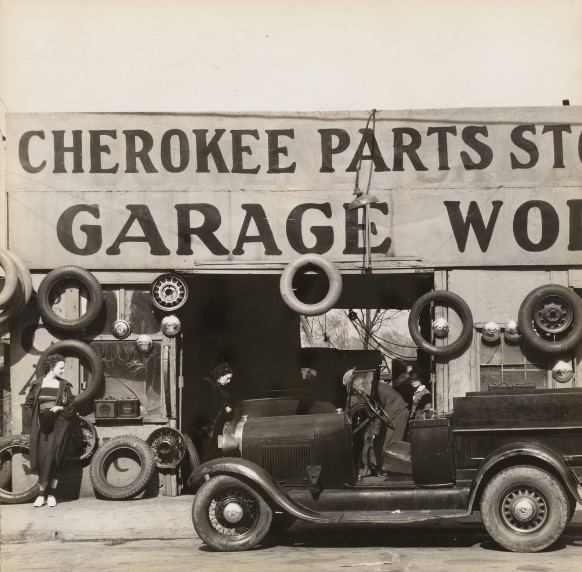
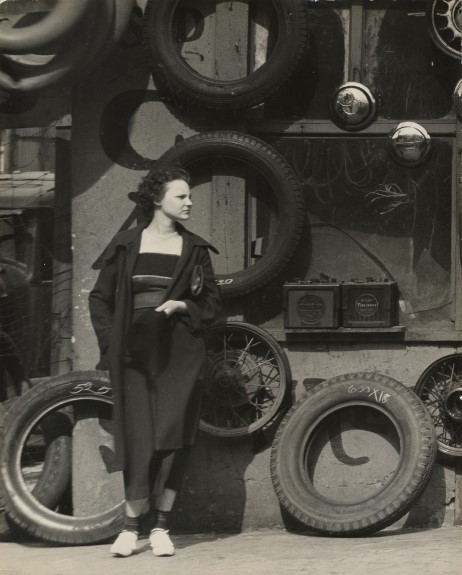
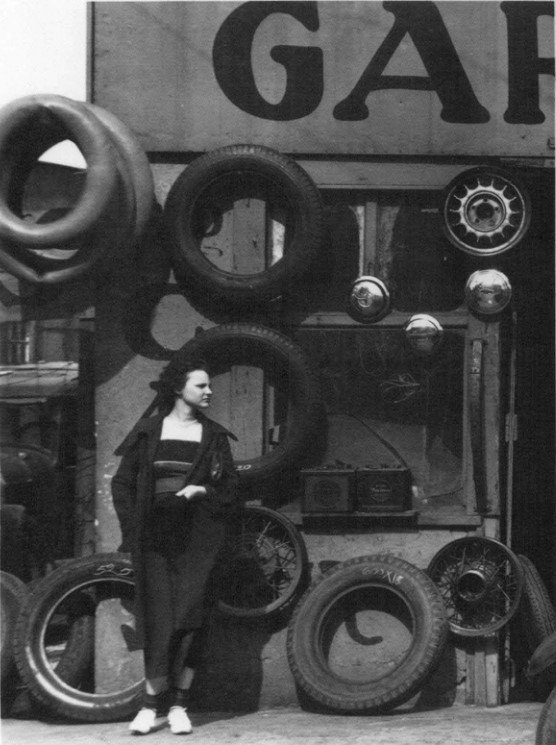
Anyway, Walker Evans. I don’t have the American Photographs book but I’ve looked at many of his images and have managed to get hold of a copy of the Getty book covering his life’s work. This book is fascinating as you can see him grow as a photographer and his use of framing is fantastic – often there are examples of several crops from the same negative and they are all amazing. See below for one example…Garage in Southern City Outskirts.
There was no confusion with Walker Evans.
Gestalt
An organised whole perceived as more than the sum of it’s parts NOT the whole is greater than the sum of its parts. Alternatively and perhaps more accurately it is that the whole is DIFFERENT to the sum of it’s parts.
I didn’t want to spend huge amounts of time researching this as I was conscious that being an idea initially based on psychology I could end up down the rabbit hole again. However the main principles were worth considering. I found a superb short video that articulates the main principles very neatly and with great examples. It is definitely something to come back to.
In relation to this exercise you could apply Gestalt to each individual image and to the group of images as whole. It was not something I considered deeply when I took the first set of images but It’s something I will come back to when I talk about the second set.
For these first set of images I used AUTO and f2.8 28-70 lens. My images were initially taken during a two hour walk around a National Trust garden. The grid was already turned on my camera as I tend to use it by default. One element of this exercise that I had to consider was that by normally using a grid I find myself naturally settling on a point to compose using the rule of thirds but as in this exercise we were to only consider one point of the image I felt that ‘composing’ had to happen quickly or I would introduce more consideration of the rest of the frame and therefore consciously make changes which would negate the reason for the task or at least for me feel like cheating.
I shared this image at the February OCA meetup and Robert felt that whilst it’s ok some of the images are too obvious and following the rule of thirds (the vine for example). It was felt that because the gardens are designed or mediated that the images will portray that inherent design and hence the obviousness of a composition.
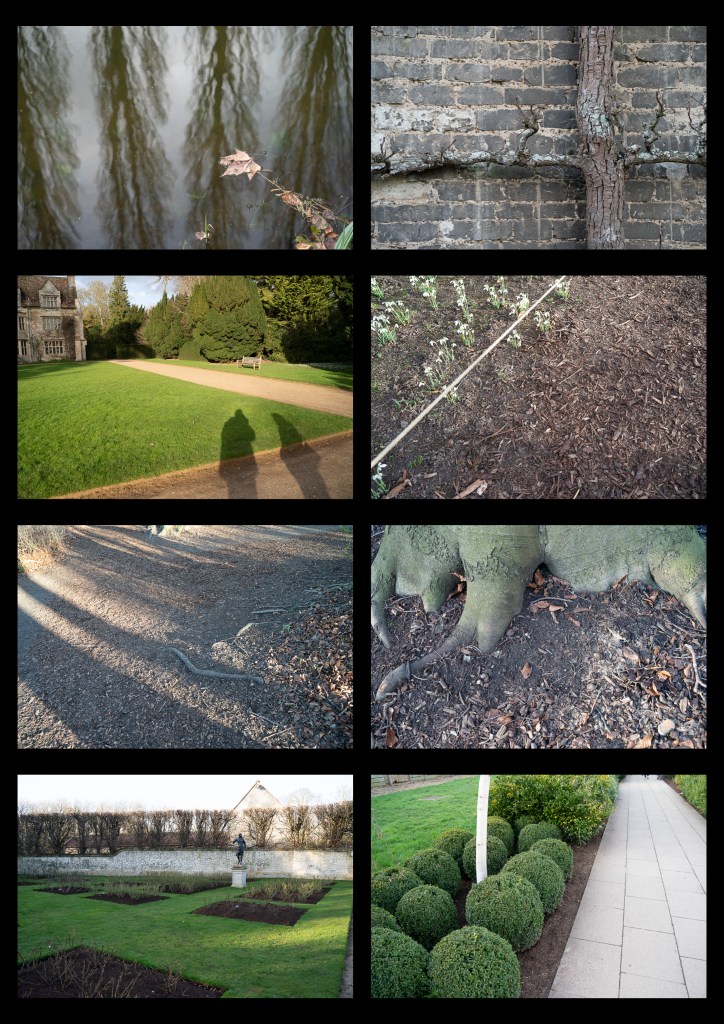
This made sense to me and I thought about the design inherent in the images and perhaps how I could counter that against something similar but different. In the final set I have included three images from the National Trust site and three images from my local managed Estate. They are both managed areas of land but one is private and effectively a working farm whilst the other is for public (albeit members) consumption. I thought it would be interesting to see how they sit side by side. The extra images taken all used the same principles – composed on one element in the frame. As a whole they follow the Gestalt principles of similarity and proximity but they are also different enough from each other to hopefully give the viewer a reason to try and understand what they are saying and why they look different. Certainly I feel they offer as a whole a lot more interest than the composite of the first set.
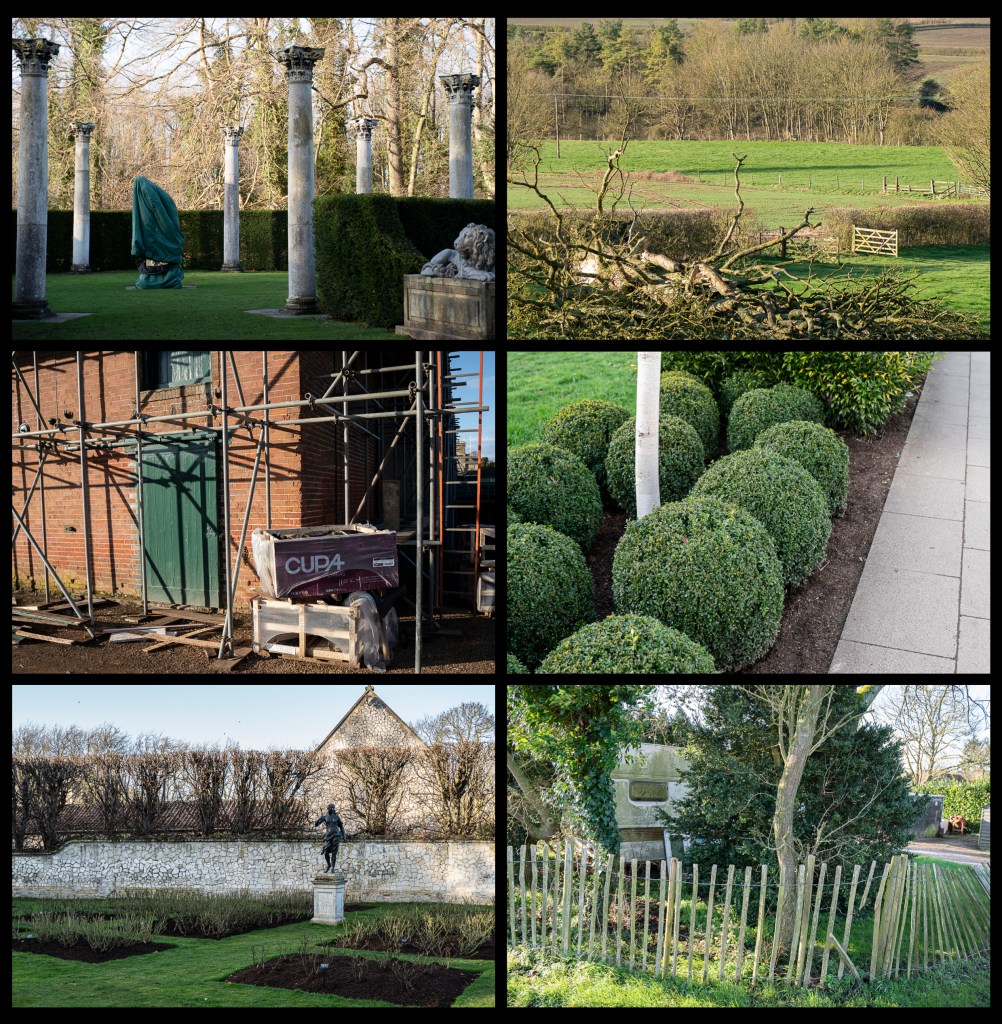
Reflection
Yet again attendance at the OCA meetup has been key to my understanding and hopefully my development. The first set of images they now appear quite boring. By adding additional elements I can start to see correlations between the frames in the second set. E.G. The concrete pillars and the silver birch to the tree below it. The covered statue and the door and then again the uncovered statue below it. The mass of broken tree branches and the scaffold. Even the gate and the fence. Far more interesting to look at.
Bibliography
Keller, J. and Evans, W. (1995). Walker Evans. Malibu, CA: J. Paul Getty Museum, p.157.
Goldberg, V. (2003). Photography in print. Albuquerque: University of New Mexico Press, p.272.
Garage in Southern City Outskirts / Garage, Atlanta, Georgia (Getty Museum) [WWW Document], n.d. . The J. Paul Getty in Los Angeles. URL http://www.getty.edu/art/collection/objects/45793/ (accessed 2.27.20).
(17) “Knocking around between money, sex, and boredom”: Walker Evans in Havana and New York – YouTube [WWW Document], n.d. URL https://www.youtube.com/watch?v=XwDqQgVKx74 (accessed 1.17.20).
Photographs, A.D. of, n.d. Walker Evans (1903–1975) | Essay | Heilbrunn Timeline of Art History | The Metropolitan Museum of Art [WWW Document]. The Met’s Heilbrunn Timeline of Art History. URL https://www.metmuseum.org/toah/hd/evan/hd_evan.htm (accessed 1.17.20).
[Subway Passengers, New York City] | Walker Evans | 1971.646.18 | Work of Art | Heilbrunn Timeline of Art History | The Metropolitan Museum of Art [WWW Document], n.d. . The Met’s Heilbrunn Timeline of Art History. URL https://www.metmuseum.org/toah/works-of-art/1971.646.18/ (accessed 1.17.20).
Torn Movie Poster | Walker Evans | 1987.1100.59 | Work of Art | Heilbrunn Timeline of Art History | The Metropolitan Museum of Art [WWW Document], n.d. . The Met’s Heilbrunn Timeline of Art History. URL https://www.metmuseum.org/toah/works-of-art/1987.1100.59/ (accessed 1.17.20).
Walker Evans, 2019. . Wikipedia. Walker Evans | Couple at Coney Island, New York | The Met [WWW Document], n.d. . The Metropolitan Museum of Art. URL https://www.metmuseum.org/art/collection/search/265145 (accessed 1.17.20).
1923-09-19-Stieglitz-How-I-came-to-photograph-clouds-American-Amatuer-Photographer.pdf, n.d. Alfred Stieglitz – Equivalent (Series) [WWW Document], n.d. URL https://www.phillipscollection.org/research/american_art/artwork/Stieglitz-Equivalent_Series1.htm (accessed 2.27.20).
Equivalents, 2019. . Wikipedia. The Alfred Stieglitz Collection | Equivalents, n.d. URL /stieglitz/equivalents/ (accessed 2.13.20).
Unrarified Air: Alfred Stieglitz and the Modernism of Equivalence | Modernism / Modernity Print+ [WWW Document], n.d. URL https://modernismmodernity.org/articles/unrarified-air#_edn2 (accessed 2.13.20).
(42) The Gestalt Principles | Basics for Beginners – YouTube [WWW Document], n.d. URL https://www.youtube.com/watch?v=FryaH599ec0&t=10s (accessed 2.12.20).
Baraban, J., 2012. 6 Principles of Gestalt Psychology That Can Improve Your Photography | Expert photography blogs, tip, techniques, camera reviews – Adorama Learning Center. 42 West, the Adorama Learning Center. URL https://www.adorama.com/alc/0013706/article/6-Principles-of-Gestalt-Psychology-That-Can-Improve-Your-Photography (accessed 1.22.20).
Gestalt psychology, 2020. . Wikipedia.
 Lee Abbey OCA Photography Degree