Compare two portraits of the same subject taken at opposite ends of the zoom range. Note the differences.
Following on from 2.1 I was relatively comfortable with the requirements for this. I decided to use my daughter as a subject on one of our ‘lockdown’ walks.
Because we were outside I wanted to ensure that background details could still be seen enough to make it obvious what the effect was – I chose f6.3 – enough to isolate the subject but with just enough depth to show how the effect of the focal length.
The two images below are taken at 28mm and at 75mm.
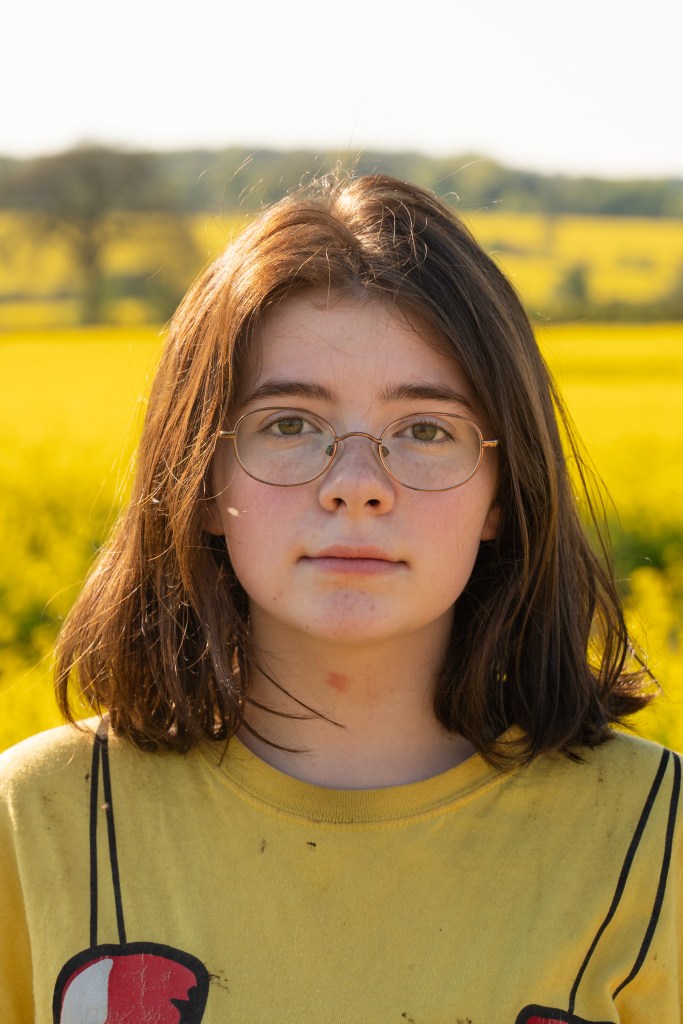
75mm – 1/320 f6.3 ISO 100 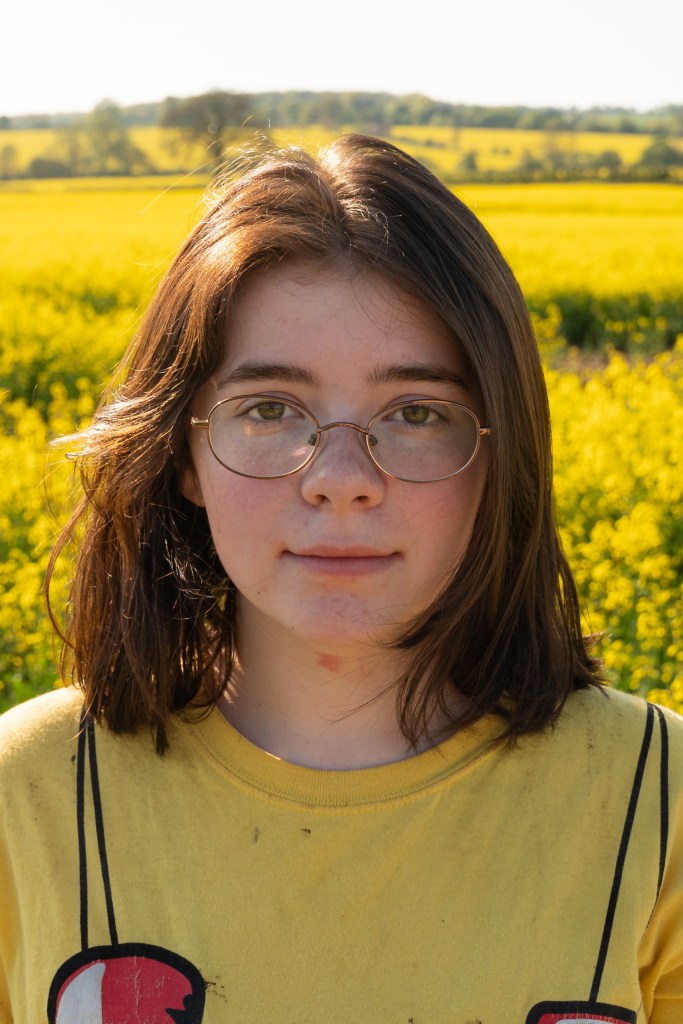
28mm – 1/250 f6.3 ISO 100
Reflection
Although this is a relatively straightforward task the execution was complicated by my choice to not use a tripod and the uneven land of the field. However eventually we managed to get something that was similar enough in composition to include. I found this to be a very useful reminder of just how much difference focal length and f stops can have not just on the composition but on everything around it.
Obvious comparisons between these two images are :-
- Background blur – even at 6.3 the 75mm lens has blurred all background details and isolated the composition. This is accentuated because of the relatively short distance between myself and the subject. In the 28mm image there is some blur to the background but it is a very gradual fall off with the individual rape plants being distinguishable in the foreground.
- Perspective – The 75mm portrait is far more flattering, it produces a more natural image without accentuating any particular facial features – straight on it flattens the face a little. The 28mm distorts the center of the face making the nose look bigger and the head slightly more bulbous. This is due to the distance between myself and the subject which at this focal length is a only a meter or two.
- Zoom – You can see in the background the effect of going from 28 to 75. The tree that appears as a small detail above left of the subject in 28mm is blurred out but distinguishable on 75mm and takes up far more of the frame.
This is harder to execute than it seems. I didn’t want to use a tripod which would have made the task a little easier and the uneven ground where I shot meant that moving forwards altered the height slightly that I didn’t initially notice but was obvious in the shots when I reviewed them.
I think it’s fair to say that you wouldn’t use a wide angle for a portrait unless you were deliberately going for an effect (I’ve seen many pet portraits taken with ultra wide angles for example) but it shows that paying attention to background details should form part of the image taking process and it’s something I will strive to do.
 Lee Abbey OCA Photography Degree